

24 Dec OEM vs ODM: Choosing the Right Manufacturing Model for Your Nutritional Supplement Brand
Introduction: Understanding Supplement OEM vs ODM
In the fast‑evolving world of nutritional supplements, brands face a pivotal decision when launching or scaling products: should they partner with a manufacturer under an OEM (Original Equipment Manufacturer) arrangement, or opt for ODM (Original Design Manufacturer)? This decision can influence everything—from cost structure and speed to market, to product differentiation, and regulatory compliance.
The rise of private label supplements and own brand health products has made the choice between OEM and ODM more relevant than ever. For a supplement brand aiming to deliver high‑quality nutritional supplements, understanding the differences between these models is crucial. The decision affects sourcing of raw materials, supplement manufacturing processes, quality control, dosage forms, packaging design, and ultimately how the product reaches the market.
Through this article, we’ll explore what OEM and ODM mean in the context of the supplement industry, compare their advantages and trade‑offs, and provide insights on how to choose the right model depending on your brand’s goals and capabilities.
What Is OEM in the Supplement Industry?
2.1 How OEM Works for Nutritional Supplements
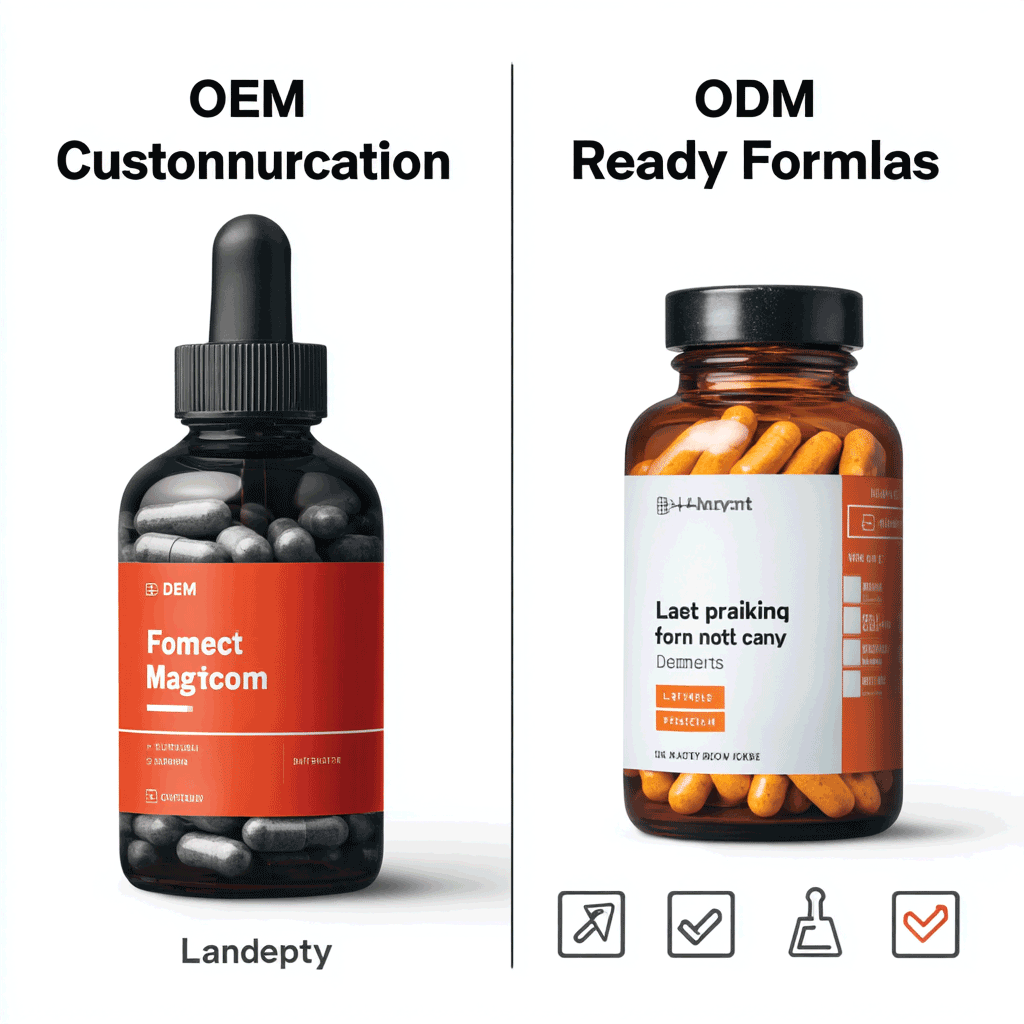
Under an OEM model, a supplement manufacturer produces products based on specifications provided by the brand owner. In essence, the brand supplies the supplement formula, design, dosing, claims, and often the label designs. The manufacturer handles sourcing of raw materials, manufacturing processes (e.g. tablet pressing, capsule filling, mixing powders), quality control, and producing the finished product. This allows brands to launch private label products under their own brand name, with a high degree of control over formulation and branding.
OEM works particularly well when the brand owner already has a vetted formulation or health‑product concept and wants full control over the final output. Through this model, a brand can create unique or niche products—perhaps a custom vitamin blend, specialized joint‑health supplement, pet supplements, or a novel functional food. Because the brand controls formulation and specifications, the final products can be tailored precisely to target demographics, dosage requirements, and market positioning.
2.2 Pros and Cons of the OEM Model
Advantages of OEM:
Custom formulation & differentiation: Because the brand owns the formula, it can create unique products that stand out in the crowded supplement market. This supports long-term brand building.
Brand identity and exclusivity: Products are made only for that brand. There is no risk that the same formula will appear under competing labels.
Flexibility in dosage forms and packaging design: Whether you want tablets, capsules, softgels, powders, or functional food forms—OEM lets you define the dosage forms and packaging layout.
Control over raw materials & quality standards: The brand can demand specific raw‑material sourcing, third‑party certification, and rigorous quality control to meet food safety and regulatory standards.
Challenges of OEM:
Higher development cost and longer lead times: Custom formulation, stability testing, compliance paperwork, and batch testing all add time and cost before going to market.
Regulatory complexity: As the brand defines the formulation, it must ensure compliance with relevant regulations (e.g. label claims, dosage limits, manufacturing practices) in every market it sells.
Inventory and demand risk: Because products are unique, predicting demand and managing inventory can be more difficult. Overstocking can lead to waste, especially for formulations with limited shelf life.
OEM is best suited for brands that aim for long-term differentiation, have clear formulation ideas, and are committed to high standards of quality control and brand identity.
What Is ODM in the Supplement Industry?
3.1 How ODM Works in Health Product Manufacturing
The ODM model offers a different approach: instead of providing your own formula, you select from existing, pre-developed formulas that a manufacturer has already validated. The manufacturer handles everything from sourcing raw materials, manufacturing, quality assurance, and brings a finished product to market — ready for branding and packaging under your name. Essentially, you adopt a “ready-made” supplement, add your brand’s label, packaging design, and begin selling.
This model is often referred to as white-label in other industries. In the supplement world, it enables newer or smaller brands to enter the market quickly, bypassing the time and cost of formulation development, regulatory testing, and initial production setup.
3.2 Pros and Cons of the ODM Model
Advantages of ODM:
Speed to market: Since formulas are already developed and tested, you can get your products to market much faster than with OEM.
Lower upfront cost and reduced risk: No need to invest heavily in R&D or raw-material sourcing; less financial pressure for new entrants.
Wide variety of dosage forms and existing formulations: Many manufacturers already offer standard tablets, capsules, soft gels, powders, and even functional food forms.
Limitations of ODM:
Limited customization: Since the formula is pre-developed, customization of ingredients, dosage, or unique health benefits is limited.
Less brand exclusivity: The same formula might be available to other brands, which can reduce differentiation in the marketplace.
Potential conflicts with regulatory compliance: While the manufacturer ensures quality, responsibility for labeling, marketing claims, and compliance with local regulations usually rests with the brand owner. This may still require due diligence.
ODM is often ideal for newcomers, brands testing market interest, or those wanting to launch supplement products quickly, such as basic vitamin supplements, mineral supplements, or pet supplements under a private label.
Key Factors to Consider When Choosing OEM vs ODM
4.1 Business Goals and Brand Strategy
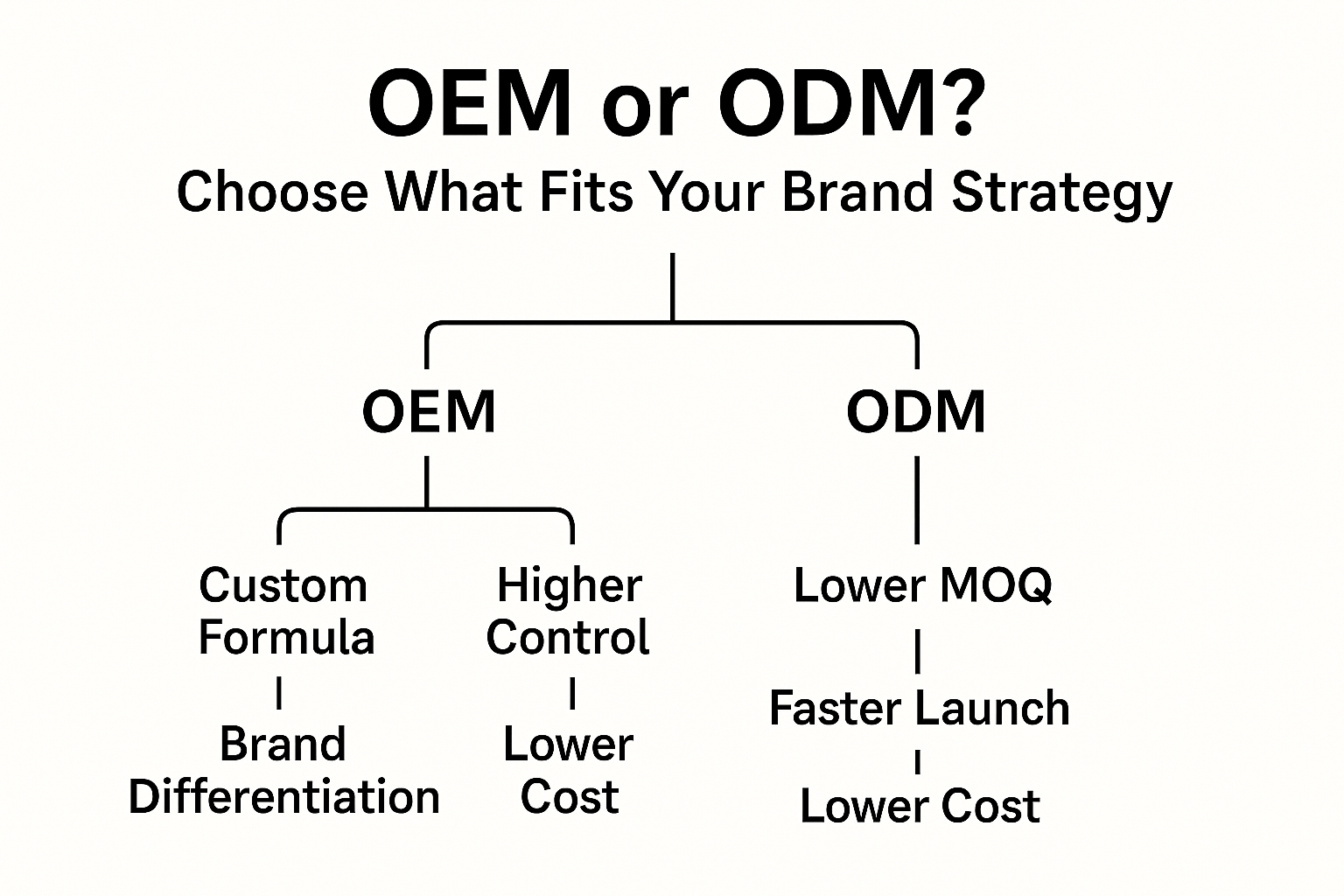
Before selecting a model, you should clarify your brand’s vision. If your goal is to build a distinct supplement brand with unique customized formulas, providing specific health benefits (e.g., joint health, high‑potency multivitamins, specialized functional foods), then OEM is likely the better choice. OEM allows you to control every aspect of the finished product: formula, ingredient sourcing, dosage form, packaging design, label designs, and final product line.
In contrast, if your priority is speed‑to‑market, cost-efficiency, and relatively lower risk—common goals for startups or new entrants—ODM can be more attractive. It allows brand owners to launch private label products quickly, test market demand, and build brand presence without the upfront burden of formulation development.
If your brand strategy emphasizes rapid expansion, launching multiple SKUs, or entering new markets quickly, ODM may provide flexibility. But if your long-term vision focuses on becoming a “top supplement manufacturer” in terms of quality and uniqueness, OEM is often worth the investment.
4.2 Cost, Minimum Order Quantities (MOQs), and Time-to-Market
Cost considerations play a major role in the decision. With OEM, because of custom formulation, testing, and validation, manufacturers typically set higher MOQs and charge higher per-unit costs initially. There may also be additional expenses associated with food safety testing, third‑party certifications (e.g., GMP, heavy-metal compliance), stability studies, and packaging setup.
On the other hand, ODM often requires lower MOQs, deferring much of the R&D and quality testing burden to the manufacturer. This reduces the initial financial risk and speeds up the production process. For brands testing new dosage forms (e.g., tablets, capsules, softgels, powders, functional foods), or those offering private label supplements in multiple SKUs, ODM reduces the barrier to entry.
However, the trade-off is less control over formulation and possibly lower differentiation. Brand owners must weigh cost and speed against long-term goals for quality, exclusivity, and identity.
4.3 Regulatory Compliance and Quality Control
Whether using OEM or ODM, adherence to regulatory requirements and quality standards is non-negotiable. Nutritional supplements are subject to varying regulations depending on country, and often oversight by relevant authorities. For OEM, the brand owner must ensure that formulations meet local regulatory requirements, labels are compliant, and dosage forms are safe and accurate. This typically involves coordinating with the supplement manufacturer to ensure documentation, testing, and Good Manufacturing Practices (GMP).
In an ODM scenario, while the manufacturer may already have compliant formulations, the brand owner still needs to ensure that the finished product, packaging design, and label comply with local laws and regulations. Regular quality audits, third‑party certification, and batch testing are crucial to maintain safety and trust.
Food safety, heavy‑metal compliance, stability testing, and ingredient traceability remain fundamental. Choosing a manufacturer — whether OEM or ODM — with proven track record, transparent processes, and third‑party certification is critical to delivering high-quality supplements and protecting consumer trust.
OEM vs ODM for Emerging Product Categories
5.1 Private Label Pet Supplements and Niche Health Products
The growth of pet health and pet supplements opens a new avenue for supplement brands and private label producers. For pet supplements, the choice between OEM and ODM depends much on the complexity of the formulation and regulatory requirements.
For simple, standard pet supplement formulas (e.g., basic vitamin blends, joint-support chews, omega fatty acids), ODM may offer an efficient route: quick launch, ready form, and acceptable compliance. But if the brand aims to develop tailored formulas for pets with specific needs (e.g., breed‑specific nutrition, hypoallergenic ingredients, specialized dosage forms), OEM offers the flexibility needed. This allows custom formulation, correct dosing, and exclusive product positioning — essential for building a unique supplement brand in the pet health segment.
5.2 Gummy Vitamins, Functional Foods, and Specialty Dosage Forms
The supplement market is evolving. Beyond tablets and capsules, functional foods, effervescent tablets, soft gels, gummies, and other dosage forms are gaining popularity. For such formats, manufacturers may already have proven formulas and production lines — making ODM a practical choice for rapid entry into emerging trends.
For example, suppose a brand wants to launch a line of adult gummy vitamins or vitamin gummies with specific health benefits. In that case, working with an ODM can offer advantages: reduced R&D cost, quick time to market, and accessible manufacturing of complex formats. On the other hand, if the brand’s concept involves custom blends, specialized ingredient sourcing, or unique dosage strength, OEM remains the superior route for customization and top quality supplements.
Building a Long-Term Partnership with a Manufacturer
6.1 What to Look for in a Supplement Manufacturer
Selecting the right manufacturer — whether under OEM or ODM — is perhaps the most important decision a brand owner makes. A reliable supplement manufacturer should offer a combination of capabilities: custom formulation, quality control, compliance with industry regulations, experience in multiple dosage forms, transparent sourcing of raw materials, and robust manufacturing and packaging processes.
Look for manufacturers with third‑party certifications (e.g., GMP, HACCP, ISO), willingness to supply documentation (certificates of analysis, heavy‑metal testing, microbial testing), and a history of supplying both standard and custom supplement lines. For brands intending to create pet supplements, specialized health supplements, or products targeting sensitive populations, choosing a manufacturer experienced in relevant regulations and food safety standards is crucial.
6.2 Scaling Your Product Line from ODM to OEM
A smart strategy for many emerging supplement brands is to start with the ODM model — leveraging existing formulas and fast production to test the market. Once demand stabilizes or grows, the brand can transition into OEM to develop proprietary formulas and build a core product line. This hybrid approach reduces initial risk, establishes market presence, and provides a pathway toward becoming a fully independent supplement brand with a differentiated portfolio.
Such an evolutionary model allows brands to refine their product line, understand customer needs, gather feedback, and then invest in custom formulation and packaging design when the market demand justifies it. Over time, this can lead to improved margins, better brand positioning, and a loyal customer base seeking high quality supplements.
Making the Right Choice for Your Supplement Business
Choosing between supplement OEM vs ODM is not a trivial decision. Each model offers distinct advantages and trade‑offs. For brands prioritizing speed, lower initial investment, and market testing, ODM delivers a low‑barrier entry path with minimal complexity. It enables quick launch of standard nutritional supplements, pet supplements, or functional health products, with less upfront cost and regulatory burden.
However, for brands aiming for long-term growth, unique formulations, strong brand identity, and differentiation in a crowded market, OEM remains the gold standard. With OEM, you control raw materials sourcing, formulation design, dosage forms, packaging, and branding — all critical in delivering tailor-made health supplements that align with your vision.
A hybrid approach — starting with ODM and gradually shifting to OEM as your brand grows — can offer the best of both worlds: quick entry, minimized risk, and potential for long-term brand development.
Ultimately, success in the supplement business depends on understanding your business goals, target market, regulatory requirements, and what kind of supplement manufacturing partnership aligns with your brand’s identity. With the right choice, strong quality control, and strategic planning, your supplement brand can navigate the challenges and seize the opportunities growing in the global health-products market.