

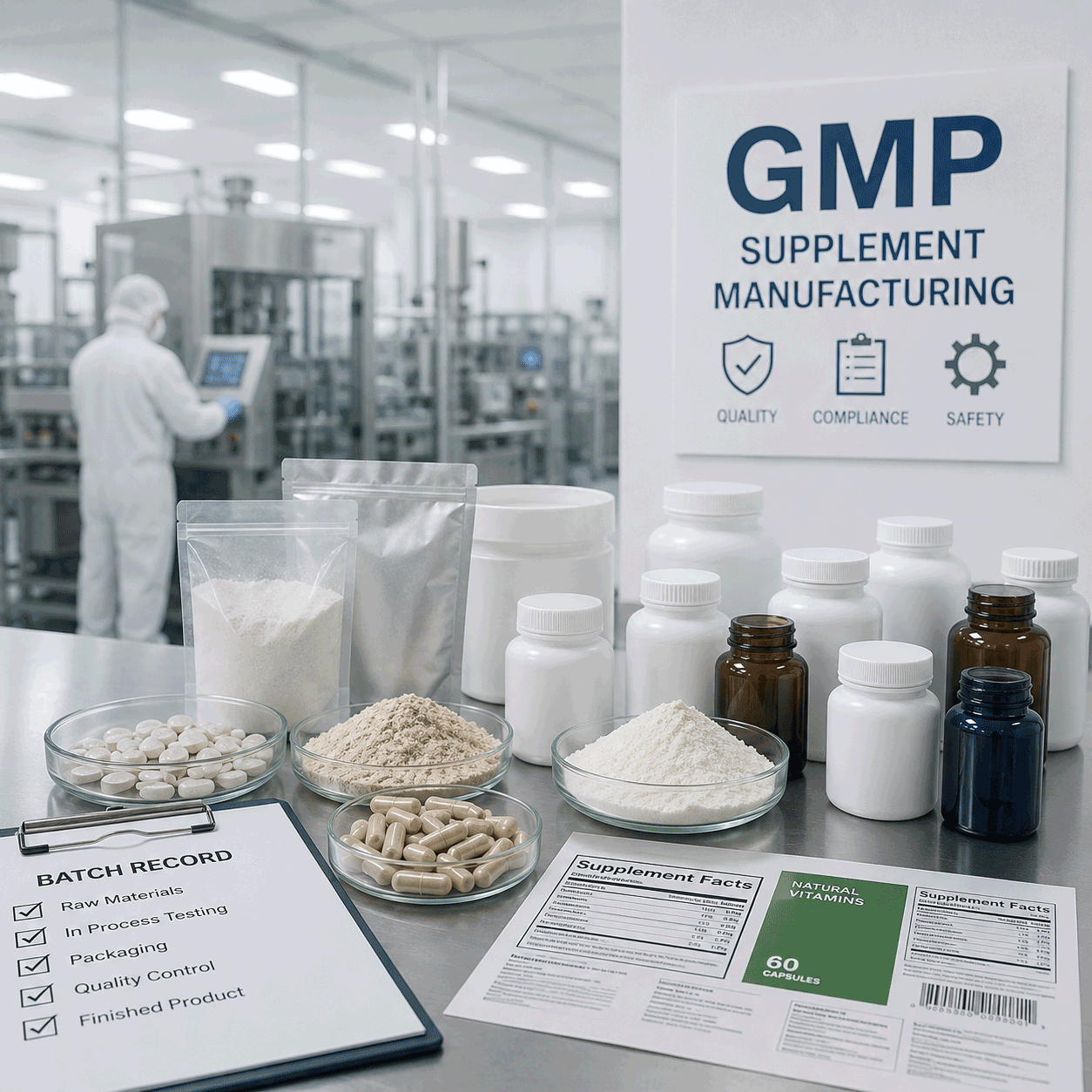
19 Oct GMP Supplement Manufacturing: What Brand Owners Should Check Before Placing an Order
For brand owners, placing a purchase order for dietary supplements is not only a sourcing decision. It is a quality, safety, compliance, and brand protection decision. A low price, fast lead time, attractive minimum order quantity, or broad product offerings may look appealing at first, but none of these factors can replace a controlled GMP supplement manufacturing system. When a brand places an order with a supplement manufacturer, it is also trusting that manufacturer with its product quality, product label accuracy, consumer safety, supply chain reliability, and long-term reputation.
GMP supplement manufacturing matters because dietary supplements are consumed directly by people who expect the product to match what is presented on the label. Consumers may take vitamins, minerals, calcium tablets, herbal capsules, sports nutrition powders, probiotics, or other nutritional supplements every day. They may not see the raw materials, the manufacturing process, the testing records, the quality control decisions, or the packaging checks behind the product. The brand owner, however, must understand these details before placing an order.
In the United States, dietary supplement manufacturers are subject to current good manufacturing practices under 21 CFR Part 111 when they manufacture, package, label, or hold dietary supplements. The rule requires certain activities in manufacturing, packaging, labeling, and holding to help ensure that a dietary supplement contains what it is labeled to contain and is not contaminated with harmful or undesirable substances such as pesticides, heavy metals, or other impurities. The Food and Drug Administration also explains that the dietary supplement CGMP rule requires qualified employees, assigned quality control responsibilities, written procedures, specifications, production and process controls, and other controls related to manufacturing, packaging, labeling, and holding operations.
For brand owners selling in Canada, the compliance picture is also important. Health Canada’s good manufacturing practices guide for natural health products applies to organizations and companies involved in manufacturing, packaging, labelling, importing, distributing, storing, testing, or holding a product licence for natural health products. For the European Union, food supplements are regulated as foods, and EU rules include harmonized provisions for vitamins and minerals in food supplements, while substances other than vitamins and minerals may be governed by national rules or other specific EU legislation. Health claims in the EU are governed by Regulation (EC) No 1924/2006, and authorised claims must be based on scientific evidence and easily understood by consumers.
This is why brand owners should not treat GMP certification as a simple marketing badge. GMP certification can be useful, and it can help demonstrate that a facility has a quality system, but it does not remove the need for due diligence. The brand should still check raw materials, dietary ingredients, other ingredients, ingredient suppliers, testing, process validation, master manufacturing record controls, batch documentation, packaging and labeling accuracy, finished product specifications, and the manufacturer’s ability to respond to audits, complaints, and regulatory inspections.
A reliable contract manufacturer should be able to explain how the product moves through the entire manufacturing process. It should be able to show how raw materials are approved, how ingredient suppliers are qualified, how in process testing is performed, how quality control personnel review records, how finished products are released, and how the product label is checked before packaging. It should also have qualified personnel, appropriate plant grounds, hygienic practices, equipment maintenance, written procedures, and adequate documentation.
Brand owners should remember that GMP is a quality system, not proof that a supplement delivers a particular health benefit. Good manufacturing practices help reduce risk, prevent contamination and mix-ups, improve consistency, and protect product safety. They do not prove that a product claim is medically effective. That distinction is important because many brands confuse product quality with product efficacy. A supplement may be manufactured under current good manufacturing practices and still need separate scientific, regulatory, and label review before any health-related claim is used.
The purpose of this guide is to help brand owners ask better questions before placing an order. It is written for supplement brands, private label companies, distributors, importers, retailers, and startup brands that need high quality products but may not have the necessary expertise to evaluate every manufacturing detail. It focuses on what to check before production begins, what to verify during production, and what documents should be available before finished products are released.
GMP Supplement Manufacturing Basics: Why Brand Owners Should Check More Than Price and MOQ
What GMP Supplement Manufacturing Means for Dietary Supplements
GMP supplement manufacturing refers to a controlled system for producing dietary supplements under current good manufacturing practices. It covers more than the factory floor. It includes plant grounds, personnel, equipment, raw materials, other ingredients, production and process controls, quality control, packaging, labeling, holding, record keeping, complaint handling, and product release. The purpose is to ensure that dietary supplements are made consistently and that the finished product meets established specifications.
In 21 CFR Part 111, the current good manufacturing practice requirements apply to manufacturing, packaging, labeling, or holding operations for dietary supplements. The regulation includes requirements related to personnel, plant and grounds, sanitation, equipment and utensils, production and process controls, quality control, components, packaging, labels, master manufacturing records, batch production records, laboratory operations, manufacturing operations, packaging and labeling operations, holding and distribution, returned products, complaints, and records.
For a brand owner, this means GMP is not a single document. It is not only a certificate, a clean room photo, or a stainless steel production line. It is a system that should be visible in how the manufacturer manages daily operations. If a contract manufacturer cannot explain how its quality system works, how it controls dietary ingredients, how it reviews the product label, how it prevents contamination, or how it documents the manufacturing process, the brand should be cautious.
GMP supplement manufacturing begins before the first batch is produced. It begins with the product concept, the formula, the raw materials, the dietary ingredients, the other ingredients, the target market, the regulatory requirements, and the retailer quality requirements. A product intended for the United States may need a different label review and compliance approach from a product intended for the European Union or Canada. A product containing only common vitamins and minerals may have different risks from a botanical product, a probiotic powder, a high-mineral tablet, or a complex sports nutrition formula.
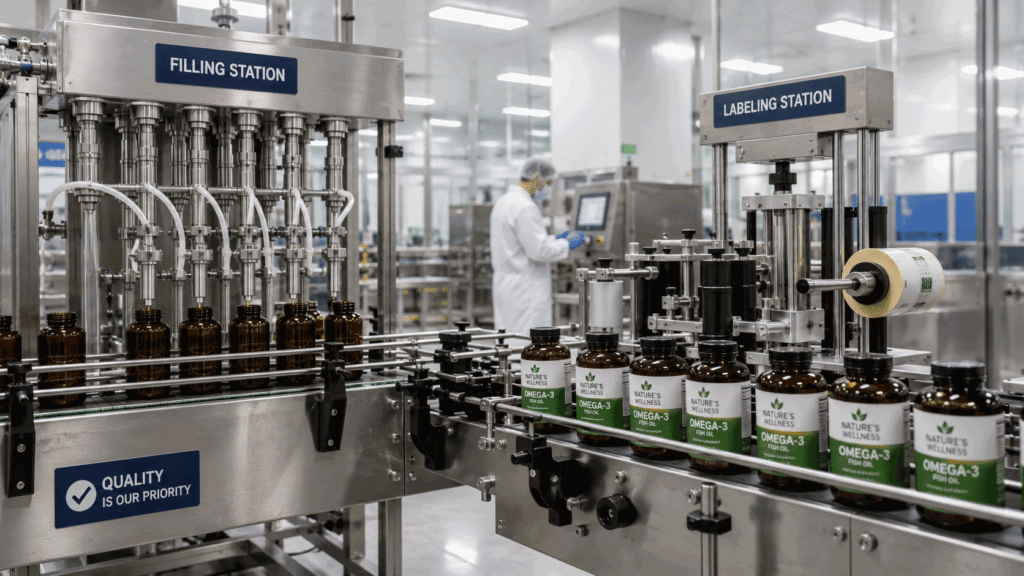
The manufacturing process must be defined before production. This includes weighing, blending, granulation, encapsulation, tableting, gummy production, powder filling, softgel filling, packaging, labeling, and holding, depending on the dosage form. For each process, the manufacturer should understand which parameters affect product quality. These may include weight, mixing time, temperature, humidity, compression force, fill weight, seal integrity, microbial control, heavy metals risk, and storage conditions.
Production and process controls are especially important because they turn written specifications into actual product quality. The regulation requires a system of production and process controls covering all stages of manufacturing, packaging, labeling, and holding so that the dietary supplement is manufactured, packaged, labeled, and held in a way that ensures quality. In practical terms, this means the manufacturer should not rely on guesswork. It should have written procedures, trained personnel, suitable equipment, controlled materials, and documented checks.
The brand owner should also understand the difference between a dietary supplement manufacturer and a trading company. A manufacturer should be able to explain actual production. It should know the equipment used, the batch size, the quality control steps, the production time, the cleaning process, and the packaging process. A trading company may be useful in some cases, but if the brand owner is placing a serious order, it should know who is actually producing products and who is responsible for regulatory compliance.
High quality products are not created at the end of the process. They are built into the process from the beginning. If raw materials are not controlled, finished product testing alone may be too late. If the master manufacturing record is weak, batch consistency may suffer. If quality control personnel are not independent or qualified, product release decisions may be unreliable. If labeling is not reviewed, a technically well-made product may still be non-compliant.
For brand owners, the key question is not simply whether a factory says it follows good manufacturing practices. The more useful question is whether the manufacturer can show how good manufacturing practices are applied to this particular dietary supplement, this formula, this product label, this batch size, this packaging format, and this target market.
Why GMP Certification Is Useful but Not Enough
GMP certification can provide an important signal. It may show that a facility has been audited against a recognized standard and that the organization has some level of quality management system. It can help brand owners narrow supplier options, especially when comparing many contract manufacturers. It can also support retailer quality requirements, distributor confidence, and customer trust.
However, GMP certification is not the same as product-specific compliance. A certificate does not prove that every raw material in a specific formula is suitable. It does not prove that every dietary ingredient complies with the target market. It does not prove that the product label is acceptable. It does not prove that the finished product meets retailer requirements. It does not prove that the manufacturer’s process validation is appropriate for the brand’s formulation. It also does not prove that the manufacturer has the necessary expertise for every dosage form or every category of nutritional supplements.
A brand owner should therefore use GMP certification as a starting point, not the end of supplier review. The next step is to check whether the manufacturer can support the actual product. For example, if the product contains minerals such as calcium, magnesium, zinc, or iron, the brand should ask how the manufacturer manages heavy metals and mineral identity testing. If the product contains botanicals, the brand should ask about adulteration risk, pesticide residue risk, microbial contamination, and supplier qualification. If the product contains probiotics, the brand should ask about temperature control, moisture control, viability testing, and shelf life. If the product contains strong flavors or allergens, the brand should ask about cleaning and cross-contact controls.
Independent third-party testing can also add value, especially for high-risk ingredients or products intended for demanding retailers. Brand owners should not assume that GMP certification eliminates the need for testing. GMP is a system for controlling manufacturing and quality. Independent testing can provide additional assurance about specific risks, such as heavy metals, microbial contamination, label claim, identity, potency, or other contaminants.
The importance of contaminant control is not theoretical. Peer-reviewed research has documented heavy metal concerns in some traditional herbal products. One widely cited study found that a significant proportion of Ayurvedic medicines purchased online contained detectable lead, mercury, or arsenic. Another analysis of herbal medicine products reported that 14 of 70 products tested contained lead, mercury, or arsenic at levels above regulatory standards. These examples do not mean that all herbal or botanical supplements are unsafe, but they show why brand owners should take raw material testing and contaminant control seriously.
GMP certification also does not guarantee that a product will pass an inspection or audit without findings. Regulatory inspections and customer audits usually review actual records, procedures, and batch evidence. They may ask for the master manufacturing record, batch production record, raw material specifications, testing records, equipment cleaning logs, maintenance records, quality control approvals, label reconciliation, complaint files, and recall procedures. If those records are missing or inconsistent, the certificate alone will not protect the brand.
The Food and Drug Administration continues to issue warning letters when facilities fail to comply with dietary supplement CGMP requirements. Recent warning letters have cited serious violations of 21 CFR Part 111 after inspections of dietary supplement facilities. For brand owners, this reinforces an important point: the manufacturer’s quality system must work in daily operations, not only during certification audits.
The financial costs of poor supplier selection can be significant. A brand may lose inventory, face delayed launches, pay for retesting, destroy non-compliant batches, relabel products, respond to retailer complaints, handle customer refunds, or manage recalls. Worse, a quality issue can damage consumer trust. A cheaper supplier may become much more expensive if the product fails testing, is mislabeled, or cannot provide adequate documentation.
A good manufacturer should be transparent. It should be willing to explain its GMP system, provide relevant certificates, share reasonable documentation, answer technical questions, and support audits when appropriate. It should not hide behind vague statements such as “we are GMP” without showing how quality is controlled. For brand owners, the most trustworthy supplement manufacturers are the ones that can connect certification, documentation, process control, testing, and product-specific regulatory requirements.
Manufacturing Process and Master Manufacturing Record: What Happens Before Production Starts
Check Raw Materials, Dietary Ingredients, Other Ingredients, and Ingredient Suppliers
Before placing an order, brand owners should understand how the manufacturer controls raw materials, dietary ingredients, and other ingredients. This is one of the most important steps in GMP supplement manufacturing because final product quality depends heavily on input material quality. If raw materials are misidentified, contaminated, weak, unstable, adulterated, or unsuitable for the target market, the finished product may fail even if the production line runs perfectly.
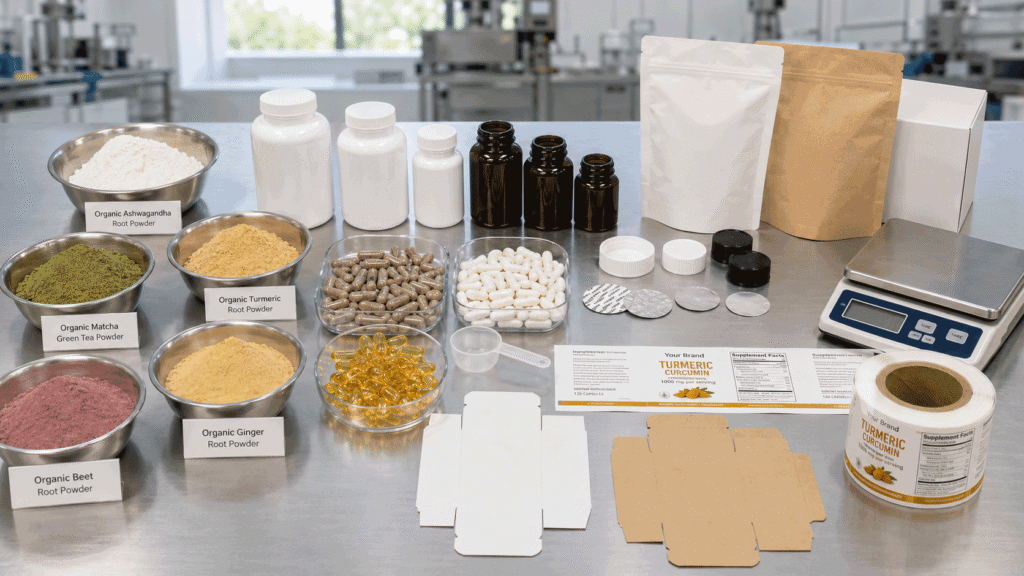
Dietary supplements often contain multiple categories of materials. These may include vitamins, minerals, amino acids, botanical extracts, probiotics, enzymes, fibers, oils, sweeteners, flavors, colors, excipients, capsule shells, coating materials, packaging components, labels, bottles, caps, pouches, cartons, and desiccants. Every material should have a defined role, an approved supplier, and a specification. The brand owner should ask whether the manufacturer has a supplier qualification process for ingredient suppliers and packaging suppliers.
Supplier qualification is part of supply chain risk management. It should not be limited to comparing prices. A qualified supplier should be able to provide documentation, consistent quality, traceability, and support when questions arise. For high-risk dietary ingredients, the manufacturer may need more than a certificate of analysis from the supplier. It may need identity testing, contaminant testing, audit information, country-of-origin review, adulteration risk review, and supplier history.
In the United States, 21 CFR Part 111 requires manufacturers to establish specifications for components, in-process production, packaging, labels, and finished products, and to determine whether specifications are met. FDA’s small entity compliance guide also explains that the DS CGMP rule includes quality control responsibilities, specifications, and requirements around components, packaging, labels, and product quality. This means a brand owner should ask how the manufacturer determines that each material is acceptable before use.
Testing is especially important for dietary ingredients. The FDA’s dietary supplement CGMP framework includes requirements related to component identity and other specifications. While the exact testing strategy may depend on the ingredient, supplier qualification, and applicable regulatory requirements, the brand owner should not accept a vague answer such as “the supplier provides the CoA.” A supplier CoA can be useful, but the manufacturer should have a scientifically sound system to verify materials and determine whether the CoA can be relied upon.
For some products, the risk of heavy metals deserves special attention. Minerals, botanicals, marine ingredients, clays, algae, and some traditional herbal materials may have higher contaminant risks depending on source and processing. Testing may include lead, arsenic, cadmium, mercury, or other contaminants. For botanical products, pesticide residues, microbial contamination, solvent residues, adulteration, and identity may also matter. For probiotics, viability, strain identity, moisture, and storage conditions may be important. For vitamins, potency and stability may be key concerns.
Other ingredients can also create compliance issues. Sweeteners, colors, flavors, excipients, preservatives, and processing aids may be permitted in one market but restricted in another. A brand selling in the EU should not assume that a formula developed for the United States can be sold unchanged in Europe. EFSA explains that EU food supplement rules harmonize the use of vitamins and minerals in food supplements, while substances other than vitamins or minerals may be governed by national rules or other specific EU legislation. This is highly relevant for botanicals, novel ingredients, extracts, and functional substances.
Health Canada’s natural health product framework also makes quality and market compliance important for Canada. Its GMP guide is intended for manufacturers, packagers, labellers, importers, distributors, storers, testers, and product licence holders involved with natural health products. Brand owners aiming at Canada should confirm whether the manufacturer can support documentation suitable for Canadian natural health product expectations, including specifications, testing, release, and traceability.
The manufacturer should also be able to explain how it stores raw materials. Storage conditions can affect vitamins, probiotics, oils, powders, minerals, flavors, and other ingredients. Materials may need protection from heat, humidity, light, pests, and cross-contamination. Plant grounds, warehouses, quarantine areas, approved material areas, and rejected material areas should be organized and controlled. If raw materials are stored poorly, testing at receipt may not protect the product during the full storage period.
A brand owner should ask how materials are identified after receipt. Are materials quarantined before approval? Are labels clear? Are lot numbers tracked? Are materials released by quality control personnel? Are expired materials blocked? Are rejected materials separated? Are materials weighed under controlled conditions? Are small ingredients handled with special care? These questions help determine whether the manufacturer truly controls the supply chain.
The brand should also clarify who is responsible for ingredient compliance. Some contract manufacturers provide full formulation and ingredient sourcing support. Others only manufacture based on a formula provided by the brand. In either case, responsibilities should be clear. If the brand supplies raw materials, the manufacturer still needs to decide whether it can accept and use those materials under its quality system. If the manufacturer sources ingredients, it should support documentation and traceability.
A strong raw material system protects both product safety and brand value. When raw materials are controlled, the manufacturing process becomes more predictable. When raw materials are not controlled, quality control becomes reactive and expensive. Brand owners should therefore review raw material control before placing the first order, not after a failed batch.
Why the Master Manufacturing Record Protects Product Consistency
The master manufacturing record is one of the most important documents in GMP supplement manufacturing. It defines how a particular dietary supplement is supposed to be made. It connects the formula, raw materials, batch size, production steps, equipment, process controls, packaging components, product label, specifications, and quality checks into one controlled manufacturing instruction.
Under 21 CFR Part 111, a manufacturer must prepare and follow a written master manufacturing record for each unique formulation of a dietary supplement and for each batch size. The regulation also specifies what the master manufacturing record must include, such as the name of the dietary supplement, the strength, concentration, weight, or measure, and other required manufacturing information.
For brand owners, the master manufacturing record is important because it protects consistency. Without a clear master manufacturing record, one batch may be made differently from the next. A powder may be mixed for a different time. A capsule may have a different fill weight. A tablet may use different compression force. A gummy may have different cooking parameters. A label may be applied differently. A packaging component may be changed without proper control. These variations can affect product quality and consumer trust.
The master manufacturing record should be created before routine production. It should not be improvised on the production floor. It should define the formula and the process in enough detail that qualified personnel can follow it consistently. It should include the identity and quantity of components, equipment to be used, manufacturing steps, control points, sampling requirements, packaging and labeling instructions, and expected yield or other process expectations. The batch production record then documents what actually happened when a specific batch was made.
The master manufacturing record is also the basis for production and process controls. If a formula requires specific mixing time, the record should state it. If a capsule product requires a target fill weight and acceptable range, the record should define it. If a tablet requires in process testing for weight and hardness, the record should include it. If a powder sachet requires net weight checks, the record should define them. If the product requires specific packaging and dietary supplement labels, those details should be controlled.
Brand owners do not always receive the full master manufacturing record because it may contain confidential manufacturing details. However, they should still ask whether the manufacturer has a product-specific master manufacturing record and whether production will follow it. They can request confirmation that the formula, batch size, packaging format, label version, and specifications are approved before the production run begins.
The brand should also ask whether the manufacturer uses a batch production record for every batch. 21 CFR Part 111 requires a batch production record every time a batch of dietary supplement is manufactured. This record is critical because it documents actual production, including materials used, equipment, processing steps, in process testing, deviations, packaging, labeling, and quality review. If a manufacturer cannot provide at least a batch record summary or release documentation, the brand may have limited traceability.
Process validation may also be relevant, especially for complex products or high-volume production. In supplement manufacturing, process validation should be understood as evidence that the manufacturing process can consistently produce a product that meets specifications. The level of validation may depend on the dosage form, risk, product complexity, and regulatory expectations. At minimum, the manufacturer should demonstrate that the process has been developed, controlled, and monitored.
For example, a protein powder blend may require blend uniformity checks or validated mixing time. An electrolyte powder may require control of particle size segregation. A probiotic powder may require temperature and moisture control. A calcium tablet may require weight, hardness, friability, and disintegration control. A gummy may require weight, moisture, texture, and microbial control. Each product has different process controls, and the master manufacturing record should reflect those needs.
The brand owner should also review how changes are managed. If the manufacturer changes ingredient suppliers, raw material specifications, equipment, batch size, packaging, label content, or process conditions, the brand should be notified when the change affects the product. Change control protects consistency and prevents accidental non-compliance. It is especially important when a brand sells through retailers with strict quality requirements or in multiple regulatory markets.
A good master manufacturing record is not just a compliance requirement. It is a business tool. It helps the manufacturer reproduce the product reliably, train personnel, investigate deviations, support audits, and defend product quality. For brand owners, confirming that the manufacturer has strong master manufacturing controls is one of the best ways to reduce future quality risk.
Quality Control in GMP Supplement Manufacturing: What Brand Owners Should Verify
Quality Control Checks for Raw Materials, In Process Testing, and Finished Products
Quality control is the part of GMP supplement manufacturing that protects the product before, during, and after production. It is not only final product testing. It includes raw material review, supplier qualification, component specifications, in process testing, batch record review, deviation review, packaging and labeling checks, finished product testing, storage review, and release decisions.
FDA’s small entity compliance guide states that the DS CGMP rule requires identification of who is responsible for quality control operations and that each person identified to perform quality control operations must be qualified and have distinct and separate responsibilities from other responsibilities. This matters because quality control should not be treated as a casual production task. Quality control personnel should have the authority and necessary expertise to approve or reject materials, processes, and finished products.
Quality control begins with raw materials. Before use, materials should be reviewed against specifications. For dietary ingredients, the manufacturer should have a defined system for identity, purity, strength, composition, and contamination limits where applicable. Other ingredients and packaging components should also be controlled. The manufacturer should be able to explain how it determines that raw materials meet component specifications before use.
In process testing is the next layer. During production, the manufacturer should check whether the process remains under control. For powder products, in process testing may include blend uniformity, appearance, particle distribution, moisture, or net weight. For capsules, it may include fill weight, capsule closure, appearance, and metal detection. For tablets, it may include weight, hardness, thickness, friability, and disintegration. For gummies, it may include weight, moisture, texture, appearance, and microbial risk controls. For liquids, it may include fill volume, pH, viscosity, appearance, and microbial checks.
In process testing helps identify problems before the batch is complete. If a powder blend is not uniform, the manufacturer may need to adjust mixing. If tablet weight drifts, the machine may need adjustment. If packaging count is inaccurate, the line may need to stop. If labels are misapplied, the batch may need segregation and review. These checks are part of production and process controls, not optional paperwork.
Finished product testing confirms whether the completed product meets established specifications. Depending on the product, testing may include identity, potency, microbial limits, heavy metals, moisture, disintegration, net weight, count, label claim, appearance, and other contaminants. Finished product testing should be based on the product’s risk profile and regulatory requirements. A simple vitamin tablet and a complex botanical powder may require different testing plans.
Health Canada’s natural health product GMP guide describes quality assurance as the GMP area concerned with sampling, specifications, testing, documentation, and release procedures. It also states that products should not be released for sale until their quality has been determined to be acceptable, including confirmation that specifications are met. This principle is highly relevant for brand owners selling in Canada and useful as a broader quality concept for other markets.
Quality control also includes packaging and labeling review. A product can fail even if the formula is correct but the label is wrong. GMP requires procedures to prevent mislabeling and mix-ups. Brand owners should ask how labels are approved, how label versions are controlled, how lot numbers and expiration dates are printed, how packaging line clearance is performed, and how label reconciliation is documented.
The product label is also a regulatory risk area. In the United States, dietary supplement labels must comply with applicable labeling rules, and FDA provides a dietary supplement labeling guide to help ensure that products sold in the U.S. are properly labeled. In Europe, food supplement labeling and health claims must follow EU and national rules. Claims about health benefits cannot be treated casually. EU rules on nutrition and health claims apply when companies highlight beneficial effects of products in labeling or advertising.
Brand owners should ask whether the manufacturer offers label review support, but they should also understand that the brand often remains responsible for claims and market compliance. A contract manufacturer may help identify obvious issues, but final responsibility should be defined in the agreement. If the brand provides the label artwork, the manufacturer should still verify that it is using the approved version during production.
Quality control should also address storage and holding. Finished products must be stored under conditions that preserve product quality. Heat, humidity, light, oxygen, and time can affect vitamins, probiotics, softgels, powders, and herbal products. The brand should ask whether the manufacturer controls storage conditions and how shelf life is supported.
A reliable manufacturer should not release finished dietary supplements simply because production is complete. It should release them only after quality control personnel review the batch record, testing results, deviations, packaging records, and label controls. This review protects the brand from shipping products that have unresolved quality questions.
Documents That Prove the Product Was Made Under Current Good Manufacturing Practices
Documentation is one of the strongest indicators of a manufacturer’s GMP maturity. A manufacturer may say it follows current good manufacturing practices, but documents show whether the system actually exists. For brand owners, documentation creates traceability, supports retailer quality requirements, prepares for gmp audits, and provides evidence if a complaint, import question, or recall occurs.
The first document area is supplier and raw material documentation. The brand should ask whether the manufacturer maintains supplier qualification files, raw material specifications, certificates of analysis, testing records, and incoming material release records. For high-risk ingredients, the brand may request evidence of heavy metals testing, microbial testing, pesticide testing, allergen review, or other contaminant checks. The level of access may vary, but the manufacturer should be able to explain its control system.
The second area is the master manufacturing record and batch production record. The master manufacturing record defines the standard process. The batch production record documents actual production. Together, they show whether the product was made according to approved instructions. A brand owner may request a batch record summary, certificate of manufacture, or release statement if the full record contains confidential details.
The third area is quality control documentation. This includes in process testing records, finished product testing results, certificates of analysis, deviation reports, nonconformance records, quality approvals, and product release records. If the product is tested by an outside laboratory, the brand should know whether the laboratory is qualified and whether the test methods are appropriate. For some products, independent third-party testing can provide added confidence.
The fourth area is packaging and labeling documentation. This includes approved artwork, label version control, packaging component specifications, label reconciliation records, lot code records, expiration date checks, packaging line clearance, and tamper-evident packaging checks where applicable. Packaging is a common source of quality failure, so documentation should be taken seriously.
The fifth area is equipment, cleaning, and maintenance documentation. Equipment logs can show which equipment was used for the batch. Cleaning records can show whether equipment was cleaned before use. Maintenance records can show whether equipment was in proper condition. Calibration records can show whether scales, checkweighers, thermometers, and other measuring instruments were reliable. If these records are weak, the batch record may not be fully trustworthy.
The sixth area is complaint, recall, and traceability documentation. GMP documentation should allow the manufacturer and brand owner to trace finished products back to raw material lots, production batches, packaging lots, and distribution records. If a problem occurs, the brand must know which lots are affected. Traceability reduces response time and increases protection for consumers and the brand.
The brand owner should also clarify record retention. Under FDA’s dietary supplement CGMP framework, records have specific retention requirements, including requirements related to shelf life or distribution timing depending on the record type and product situation. FDA’s small entity compliance guide discusses record and reserve sample expectations for packaged and labeled dietary supplements. The key point for brand owners is that records should be maintained long enough to support quality investigations, complaints, retailer inquiries, and regulatory inspections.
Documentation also affects financial costs. If a retailer asks for a finished product CoA and the brand cannot provide it, shipment may be delayed. If an importer asks for heavy metals testing and the brand must test after production, costs and timelines increase. If a batch has a complaint and there is no traceability, the brand may have to take broader action than necessary. If labels cannot be reconciled, the brand may face mislabeling risk. Good documentation reduces uncertainty.
Brand owners should not demand unrealistic access to every confidential internal document, but they should ask for reasonable evidence. A trustworthy manufacturer can usually provide a certificate of analysis, product specification, batch release confirmation, testing summary, packaging confirmation, and traceability support. If the manufacturer refuses to provide any meaningful evidence, the brand should consider whether the supplier is suitable for long-term cooperation.
The most reliable manufacturers are usually not the ones that only say “trust us.” They are the ones that can show, in a controlled and professional way, how the product was made, tested, packaged, labeled, and released under current good manufacturing practices.
Market Compliance, Retailer Requirements, and Regulatory Inspection Readiness
U.S., Canada, and EU Compliance Considerations Before Placing an Order
Before placing an order, brand owners should define the target market. A product sold in the United States, Canada, and the European Union may face different regulatory requirements even if the formula looks similar. The manufacturing process, product label, ingredient review, claims, testing, documentation, and import requirements may all change depending on market.
In the United States, dietary supplements are regulated under the Federal Food, Drug, and Cosmetic Act and related regulations, including 21 CFR Part 111 for current good manufacturing practices. The Food and Drug Administration does not approve most dietary supplements before they are marketed in the same way it approves drugs, so the manufacturer and brand owner must take responsibility for product safety, labeling, and compliance. The DS CGMP rule is designed to ensure that dietary supplements are manufactured, packaged, labeled, and held in a controlled way and are not contaminated with harmful or undesirable substances.
For U.S. orders, brand owners should verify whether the manufacturer understands dietary supplement labeling, lot coding, expiration dates, reserve samples, complaint handling, and recall support. The manufacturer should be prepared for regulatory inspections and should understand how to maintain records under 21 CFR Part 111. If the product is imported into the United States, the brand should also consider import documentation and supplier accountability.
In Canada, nutritional supplements may fall under the natural health product framework depending on product type, ingredients, claims, and presentation. Health Canada’s good manufacturing practices guide for natural health products is intended to help organizations comply with Part 3 of the Natural Health Products Regulations and applies to multiple roles, including manufacturing, packaging, labelling, importing, distributing, storing, testing, and holding product licences. Brand owners selling into Canada should confirm whether their contract manufacturer can support documentation needed for product quality, testing, and release.
Health Canada’s quality guidance also emphasizes that licence holders are responsible for ensuring high quality natural health products. This is a useful reminder for brand owners: even when manufacturing is outsourced, the brand’s compliance responsibilities do not disappear. If the brand is the licence holder, importer, distributor, or marketer, it may still need to manage product documentation and regulatory obligations.
In the European Union, food supplements are regulated as foods. EFSA explains that the food supplement directive lays down rules only for vitamins and minerals used in food supplements, while substances other than vitamins or minerals may be governed by national rules or other EU legislation. This makes EU compliance more complex for products containing botanicals, extracts, novel substances, or other ingredients outside basic vitamins and minerals.
EU health claims require special care. The European Commission states that nutrition and health claims are governed by Regulation (EC) No 1924/2006, which applies when food business operators highlight beneficial nutritional or health effects on product labels or advertising. It also explains that health claims are authorised when based on scientific evidence and easily understood by consumers, with EFSA responsible for evaluating scientific evidence supporting claims.
This means a brand should not assume that a U.S. product label can simply be translated for the EU market. Claims, ingredient levels, vitamin and mineral forms, language requirements, notification procedures, and member state rules may differ. A GMP manufacturer can help with production quality, but market compliance may require additional regulatory review.
Retailer quality requirements can add another layer. Large retailers, e-commerce platforms, distributors, pharmacies, and specialty stores may require testing beyond minimum legal requirements. They may ask for heavy metals testing, microbial testing, allergen statements, non-GMO documentation, stability data, product specifications, GMP certification, third-party testing, or traceability documents. A brand owner should ask these questions before production, not after the retailer requests them.
The manufacturer’s ability to support retailer quality requirements can determine whether the product launches smoothly. A factory with a strong quality system can often provide documentation faster and with fewer problems. A factory with weak documentation may delay product listing, increase financial costs, and create unnecessary risk.
Market compliance should therefore be part of supplier selection. A brand should choose a manufacturing partner that understands not only production but also target-market expectations. The manufacturer does not need to replace the brand’s legal or regulatory advisor, but it should be able to support compliant manufacturing, documentation, testing, and packaging control.
GMP Audits, Regulatory Inspections, and Choosing the Right Contract Manufacturer
GMP audits and regulatory inspections test whether a manufacturer’s quality system works in practice. A brand owner may not be present during daily production, so audits and inspection readiness are important indicators of supplier reliability. A good contract manufacturer should not fear reasonable quality questions. It should be able to show how its manufacturing process is controlled, how quality control operates, and how records are maintained.
Before placing an order, the brand should ask whether the manufacturer allows customer audits, third-party audits, or documentation review. Some manufacturers may restrict access for confidentiality or hygiene reasons, but they should still provide a professional audit pathway. This might include facility overview, certification review, quality system questionnaire, document package, virtual audit, or on-site audit for qualified customers.
During GMP audits, reviewers may examine plant grounds, sanitation, personnel training, raw material control, equipment maintenance, production and process controls, master manufacturing records, batch production records, in process testing, quality control release, packaging and labeling, holding, returned products, complaints, and record retention. These are not abstract topics. They are practical evidence that the manufacturer can produce high quality products consistently.
Qualified personnel are essential. FDA’s small entity compliance guide states that the DS CGMP rule requires qualified employees who manufacture, package, label, or hold dietary supplements, as well as qualified personnel to supervise such operations. The brand owner should ask how operators, supervisors, quality control personnel, warehouse personnel, and maintenance teams are trained. Training should match the person’s assigned function.
The brand should also ask how deviations are handled. In real manufacturing, problems can occur. A raw material may fail testing. A machine may stop during production. A label roll may be incorrect. A batch may show unexpected test results. A reliable manufacturer does not hide deviations. It investigates them, documents them, evaluates product impact, and makes quality decisions based on evidence.
Regulatory inspection readiness is another important factor. A manufacturer serving the U.S. market should be prepared to explain how it complies with 21 CFR Part 111. A manufacturer serving Canada should understand Health Canada’s GMP expectations for natural health products when applicable. A manufacturer serving the EU should understand food supplement requirements, labeling expectations, and ingredient compliance challenges. A manufacturer that ships internationally should understand that compliance is not one-size-fits-all.
Contract manufacturers vary widely in capability. Some are strong in powders but weak in tablets. Some are good at capsules but not gummies. Some can formulate products but have limited regulatory support. Some have broad product offerings but weak documentation. Some have strong manufacturing but limited label review. The brand owner should choose based on the product’s specific needs, not only on the supplier’s brochure.
The right contract manufacturer should have the necessary expertise for the dosage form, target market, and formula complexity. For example, a probiotic powder requires different expertise from a calcium tablet. A botanical capsule requires different risk management from a basic vitamin blend. A product sold through strict retailers may require more documentation than a simple bulk order. A product with claims may require stronger regulatory review.
A good manufacturing partner also communicates clearly. It should explain timelines, testing requirements, raw material lead times, packaging artwork deadlines, stability needs, and potential risks. It should not promise unrealistic speed if testing and quality control take time. It should not accept a formula without asking whether the ingredients are suitable. It should not treat regulatory compliance as the brand’s problem only.
Brand owners should also consider long-term business needs. The first order may be small, but future growth may require larger batches, more products, new packaging formats, additional testing, or export support. A manufacturer that can scale with the brand can reduce future supply chain disruption. However, the manufacturer must also maintain quality as volume increases. High output without quality control creates risk.
The final decision should balance cost, capability, compliance, communication, and trust. Price matters, but it should not dominate the decision. A manufacturer that reduces risk, protects the brand, and supports documentation can create far more value than a cheaper supplier with weak controls.
From Purchase Order to Finished Products: What Brand Owners Should Confirm
Before the Purchase Order: Formula, Label, Testing, and Supply Chain Review
Before a purchase order is placed, the brand owner should confirm that the product is ready for manufacturing. This means the formula, raw materials, product label, packaging, testing plan, target market, and quality requirements should be clear. If these details are unclear, the purchase order may create confusion and delays.
The formula should define dietary ingredients, other ingredients, dosage, serving size, overages where appropriate, target potency, taste, color, texture, and dosage form. If the brand provides the formula, the manufacturer should review it for manufacturability. If the manufacturer develops the formula, the brand should review the formula for market positioning, compliance, and cost. In either case, the formula should be approved before production.
The product label should also be reviewed before production. Label mistakes can be expensive. If the Supplement Facts panel, ingredient list, allergen statement, claims, net quantity, suggested use, warnings, lot code area, expiration date area, or company information is incorrect, the brand may need to reprint labels or rework packaging. For U.S. products, FDA’s dietary supplement labeling guide is a relevant reference for proper labeling. For EU products, health claims and food supplement rules require separate attention.
The testing plan should be agreed before production. The brand should know what testing the manufacturer will perform and what testing may require an external laboratory. Testing may include raw material identity, heavy metals, microbial limits, potency, allergens, moisture, residual solvents, pesticides, or other contaminants. The exact plan should be based on the product category, ingredient risk, target market, and retailer requirements.
The supply chain should also be reviewed. If certain raw materials have long lead times, the production schedule should reflect that. If ingredient suppliers are new, qualification may take time. If packaging is custom, artwork approval and printing may affect lead time. If a product uses special bottles, caps, pouches, labels, or desiccants, packaging components should be approved before the manufacturing run.
The purchase order should not be vague. It should specify product name, formula version, quantity, packaging format, label version, testing requirements, delivery terms, documentation requirements, and target market where relevant. If there are retailer quality requirements, they should be communicated early. If the brand needs a finished product CoA, heavy metals report, microbial testing report, or batch record summary, that should be discussed before production.
A brand should also confirm responsibilities. Who approves the formula? Who approves labels? Who sources raw materials? Who pays for testing? Who handles regulatory review? Who approves finished product release? Who manages customer complaints? Who supports recall procedures? Clear responsibilities prevent disputes later.
Before placing the order, the brand should ask whether the manufacturer has experience producing similar products. Experience matters because formulations behave differently in real production. A manufacturer may know how to handle high-mineral tablets, sticky herbal powders, probiotic sachets, effervescent products, or difficult gummies only if it has produced similar products before. Necessary expertise can reduce development time and prevent avoidable mistakes.
The brand should also ask about pilot batches or first production evaluation. For complex formulas, a pilot batch can help identify manufacturability issues before full production. It can reveal problems such as poor powder flow, unstable flavor, tablet sticking, capsule fill variation, gummy texture issues, powder segregation, or packaging incompatibility. A pilot batch may add time and cost, but it can reduce larger financial costs later.
Finally, the brand should evaluate communication quality. A manufacturer that answers questions clearly before the order is more likely to support the brand during production. A manufacturer that gives vague answers, avoids documentation, or pressures the brand to place an order before technical details are settled may create risk.
After Production: Finished Product Release, Storage, Traceability, and Brand Protection
After production, the brand owner should not assume the order is ready to ship immediately. Finished products should be released only after quality control review. The manufacturer should review batch production records, in process testing, finished product testing, packaging records, label checks, deviations, and any required documentation before release.
The finished product CoA is one of the most important documents. It should reflect the agreed specifications and testing plan. Depending on the product, it may include appearance, identity, potency, microbial results, heavy metals results, moisture, count, weight, or other relevant tests. The brand should confirm whether the CoA is based on finished product testing, raw material testing, supplier documents, or a combination of evidence. The meaning of the CoA should be clear.
Storage conditions should also be controlled. Finished products may need protection from heat, humidity, light, oxygen, or physical damage. Probiotics, vitamins, oils, softgels, powders, and gummies may each have different stability concerns. If the product label includes storage instructions, the manufacturer should hold dietary supplements under appropriate conditions before shipment.
Shelf life and expiration date should be supported by a reasonable basis. For new products, real-time stability data may not yet be complete, but the manufacturer and brand should discuss how shelf life is justified. This may involve stability studies, ingredient data, packaging evaluation, product type, historical data, or other scientifically valid methods. The brand should avoid assigning an expiration date without understanding the basis.
Traceability is essential for brand protection. The finished product should be traceable to raw material lots, packaging lots, production batch, testing records, and distribution records. If a complaint occurs, traceability helps determine which lots may be affected. It also helps the brand respond to retailer questions, regulatory inspections, and possible recalls. Good traceability increases protection for both consumers and the brand.
Packaging and labeling records should be reviewed carefully. A product may be manufactured correctly but become non-compliant during packaging. The brand should confirm that the correct label version was used, lot number and expiration date were printed correctly, tamper-evident packaging was applied where required, and finished product count or net weight is correct. Labeling errors can create serious risk.
The brand should also ask how complaints are handled. If a consumer reports an adverse reaction, strange odor, broken tablets, leaking bottles, incorrect count, or label issue, the manufacturer should support investigation. This may involve reviewing batch records, reserve samples, testing results, raw material lots, packaging records, and storage conditions. A manufacturer that cannot support complaint investigations may leave the brand exposed.
Reserve samples can be helpful for investigations. FDA guidance discusses reserve sample expectations for packaged and labeled dietary supplements, including how long samples should be held depending on shelf life and distribution timing. Brand owners should ask whether the manufacturer holds reserve samples and under what conditions.
Finished product documentation should be stored securely. The brand should maintain its own records as well, including purchase orders, specifications, labels, CoAs, testing reports, shipping records, and communications. Outsourcing manufacturing does not mean outsourcing all responsibility. The brand should retain enough documentation to protect itself.
A strong post-production process also supports future orders. If the first batch performs well, the brand may reorder. The master manufacturing record, batch record, supplier records, and quality review help ensure the next batch is consistent. If adjustments are needed, they should be managed through change control rather than informal changes.
Brand protection is the final reason to care about GMP supplement manufacturing. A supplement brand is built on trust. Consumers trust that the product contains what the label says. Retailers trust that the brand can provide documentation. Regulators expect compliance. Distributors expect stable supply. Investors expect risk control. Poor manufacturing can damage all of these relationships.
GMP supplement manufacturing is therefore not just a supplier checkbox. It is part of the brand’s operating foundation. The right manufacturer helps the brand produce high quality products, reduce risk, comply with regulations, meet retailer quality requirements, and build long-term consumer confidence.
Conclusion: Check the Quality System Before the First Purchase Order
Choosing a GMP supplement manufacturing partner is not only about price, MOQ, or lead time. It is about whether the manufacturer can protect product quality through raw material control, production and process controls, in process testing, master manufacturing record discipline, quality control, packaging accuracy, labeling review, finished product testing, traceability, and regulatory compliance.
Brand owners should check the quality system before placing the first purchase order. They should ask how raw materials and dietary ingredients are qualified, how other ingredients are controlled, how ingredient suppliers are reviewed, how the manufacturing process is documented, how quality control personnel release finished products, and how the manufacturer prepares for gmp audits and regulatory inspections.
For products sold in the United States, brand owners should understand that 21 CFR Part 111 applies to current good manufacturing practices for dietary supplements manufactured, packaged, labeled, or held for the market. For Canada, Health Canada’s natural health product GMP framework may be relevant depending on product classification and role. For the EU, food supplement rules, health claims, ingredient compliance, labeling, and member state requirements must be considered.
A reliable manufacturer should be able to support high quality products with documentation, testing, qualified personnel, clean facilities, controlled process validation, and clear communication. It should understand that GMP certification is helpful but not enough by itself. Real confidence comes from evidence: specifications, batch records, CoAs, in process testing, finished product testing, label controls, traceability, and quality review.
For brand owners, the smartest decision is to evaluate the manufacturing partner before problems appear. A strong supplier can reduce financial costs, protect consumers, support product safety, strengthen retailer relationships, and help the brand grow with confidence. In a market where consumers expect safe, consistent, and trustworthy supplements, GMP supplement manufacturing is not optional. It is the foundation of a responsible supplement brand.