

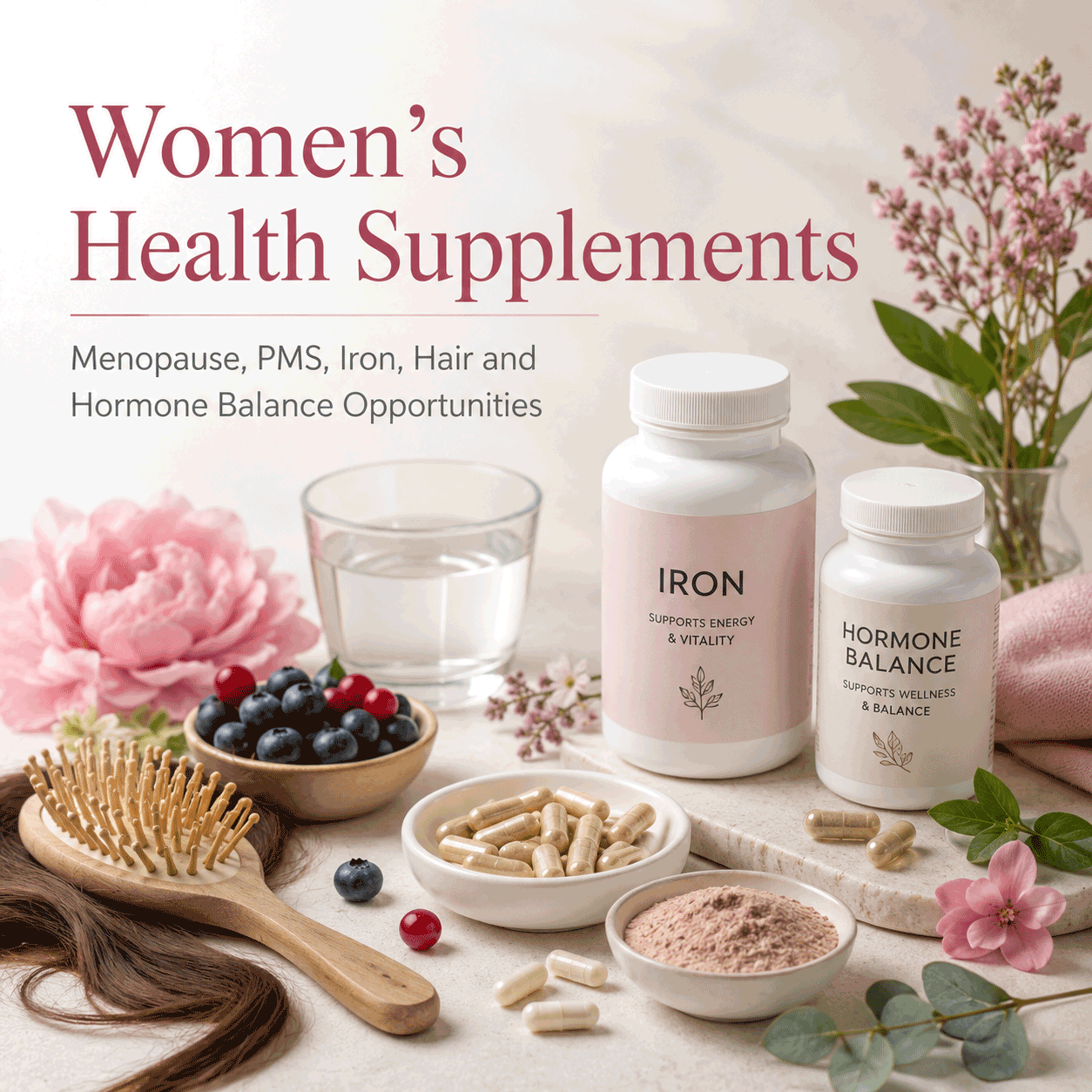
17 Nov Women’s Health Supplements Menopause, PMS, Iron, Hair and Hormone Balance Opportunitie
Women’s health is one of the strongest areas for supplement brand differentiation because nutritional priorities can change throughout a woman’s life. A customer in her twenties may be interested in a daily vitamin, iron, menstrual wellness or skin support. A woman planning pregnancy may focus on folate and prenatal nutrients. Later stages may create demand for menopause, bone health, energy, sleep, hair growth and healthy-aging products.
For a manufacturer, distributor or entrepreneur creating a women’s health supplement line, this creates much more than a single-product opportunity. A well-designed brand can develop a connected range of dietary supplements that follows customers through different life stages. The challenge is to build this range without suggesting that every woman has the same needs or that a supplement can treat hormonal, reproductive or medical conditions.
Consumers often use broad phrases such as hormonal balance, hormonal acne, PMS relief and menopause support when searching online. These terms can help a brand understand market interest, but they must be handled carefully in the final product description, packaging and labels. A food supplement should not be positioned as a substitute for medical care, birth control, hormone therapy or treatment directed by a healthcare professional.
European food businesses may use only authorised nutrition and health claims that meet the relevant conditions of use. Claims must be scientifically supported, understandable and not misleading. Medicinal claims are prohibited for food supplements. In the United States, the FDA also distinguishes between health claims, nutrient content claims and structure/function claims, while supplement manufacturers remain responsible for ensuring that claims are truthful and supported.
The strongest women’s health brands therefore combine appealing product ideas with realistic formulation, careful testing, clear instructions and responsible communication. They do not simply create a long list of ingredients and push every possible benefit onto one label. Instead, they make it easy for customers to understand which product may match a particular life stage and why.
Women’s Health Supplement Opportunities Across Reproductive Life Stages
PMS, Iron, Energy and Hormonal Balance Positioning
For women of reproductive age, PMS, monthly wellness, energy and iron are common areas of interest. However, these themes require clear separation. PMS is a collection of physical and emotional symptoms that may vary from one woman to another, while tiredness can have many nutritional, medical and lifestyle-related causes. A brand should not automatically present fatigue, mood changes or hormonal acne as proof of a vitamin or mineral deficiency.
Iron can be an important product category because menstruating women are among the groups more likely to experience iron deficiency, particularly when menstrual blood loss is heavy or dietary intake is inadequate. Research reviews have examined the role of daily iron supplementation in improving iron status among menstruating women, but the need for supplementation still depends on individual circumstances. High-dose iron may also cause gastrointestinal side effects, which makes dosage, iron form and professional guidance important.
A women’s health supplement brand could develop a focused iron product using capsules or tablets, possibly combined with vitamin C where the formulation and permitted claims support that positioning. The product description should clearly state the amount of elemental iron, the daily dosage and any relevant warnings. It should not claim that the product will deliver fast relief from every form of tiredness or restore energy immediately.
A good product may focus on nutritional support rather than symptom treatment. For example, an iron supplement can be positioned for women seeking to maintain normal iron intake, while authorised nutrient claims can be selected according to the actual formula and target market. The label should also make it easy to read the serving size, number of capsules per day and quantity of active nutrients.
PMS products are another opportunity. Formulas in this area may include selected vitamins, minerals or botanical ingredients. Calcium, vitamin D, vitamin B6, magnesium and omega-3 fatty acids have been discussed in research related to PMS, but evidence quality, effective dosage and individual response vary. A recent review identified several nutritional factors that may influence PMS symptoms, yet this does not mean every ingredient combination will be effective or suitable for every customer.
The phrase hormonal balance is commercially attractive, but it is often too vague to support a responsible product promise. Hormones are influenced by age, the menstrual cycle, pregnancy, stress, medication, body composition and health conditions. A supplement cannot simply “balance hormones” in every woman.
Brands can instead focus on monthly well being, nutritional support during the menstrual cycle or selected authorised functions of nutrients in the formula. A product may be designed around mood, energy or normal psychological function when the ingredient levels meet the legal requirements for those claims. The difference may appear small in marketing language, but it can make a major difference to regulatory compliance.
Botanical ingredients such as chasteberry, maca, lemon balm and adaptogenic plants are often discussed in consumer content. However, evidence, legal status and permitted communication can differ across markets. Some botanicals may also be inappropriate during pregnancy, breastfeeding or alongside certain medications. The manufacturer and brand must review raw material documentation, dosage, safety data and target-market rules before creating labels.
Customer expectations should also be realistic. Many dietary supplements require consistent use, and results may not be immediate or easy to measure. A brand should avoid promising that customers will see improved PMS symptoms in a fixed number of days or months. Customer reviews may describe individual experiences, but they do not prove that the formula will have the same effects in all women.
Birth Control, Hormonal Acne and Responsible Product Communication
Birth control and hormonal acne are highly searched topics, but they are not simple opportunities for supplement claims. Hormonal contraception is medication directed toward specific reproductive goals, while acne can have several causes. A supplement should not be presented as reversing the side effects of birth control, replacing contraception or treating hormonal acne.
A responsible website page can acknowledge that some women using birth control may become more interested in nutrition, skin, mood or energy. It should then direct customers to speak with a healthcare professional about medication-related concerns. The product itself can focus on its actual nutrients and authorised benefits rather than implying that it corrects an effect caused by medication.
This is especially important when formulas contain herbs. An ingredient that appears natural can still have biological effects or interact with medication. “Natural” and “organic” do not automatically mean suitable for pregnancy, contraception users, children or all customers.
A skin-focused supplement may use nutrients associated with normal skin maintenance, but the product description should not promise to remove hormonal acne. Hormonal acne may require professional assessment, particularly when it is severe, sudden or associated with other symptoms.
For a new brand, it may be tempting to use phrases such as “hormone detox,” “birth control support” or “clear hormonal skin fast.” These messages are attention-grabbing, but they create scientific and regulatory risk. They may also damage trust if the product cannot deliver the promised effects.
The stronger strategy is to build a clear brand identity around women’s nutritional care rather than around fear. Packaging can communicate quality, convenience and life-stage relevance. Labels can highlight the formula, dosage form, ingredient amounts and intended use. Educational content can encourage women to learn about nutrition and talk with a qualified professional when symptoms go beyond general wellness.
The manufacturer should be involved early in this process. A right partner can review formula feasibility, capsule size, gelatin or cellulose shell options, powder taste, active ingredient levels and packaging requirements. However, the brand remains responsible for ensuring that the product page, labels and customer communication comply with the rules of the market where the supplement will be sold.
Pregnancy, Postpartum and Long-Term Nutritional Care
Designing Pregnancy and Postpartum Supplements Safely
Pregnancy creates a very specific stage in women’s health. Nutrient requirements and safety considerations change, and a formula that is suitable for the general adult population may not be appropriate during pregnancy.
Folate is particularly important around conception and early pregnancy because it contributes to maternal tissue growth, and public-health guidance commonly emphasises adequate folate intake before and during early pregnancy. Prenatal products may also include iron, vitamin D, iodine, vitamin B12, choline or omega-3 fatty acids, depending on the intended market and formulation strategy.
However, pregnancy formulas should not be designed by simply creating a long ingredient list. Every nutrient needs to be reviewed for dosage, chemical form, upper intake considerations, interactions and total intake from food and other supplements. EFSA maintains dietary reference values and tolerable upper intake assessments for nutrients, which manufacturers and regulatory teams can use as part of safety review.
A prenatal supplement also needs clear directions. Women may already be using products recommended by a doctor or healthcare professional. The label should not encourage the customer to combine several high-dose products without reviewing total intake.
Packaging is important because prenatal products may require multiple capsules or tablets per day. A high-mineral formula can become physically large, making it difficult to deliver in one easy capsule. The manufacturer may need to divide the daily dosage across several capsules or develop a powder and capsule system.
The choice between gelatin and cellulose capsules may depend on the brand’s customer profile. Cellulose capsules can support vegetarian positioning, while gelatin may provide different manufacturing or price considerations. Neither option automatically creates a better product; the selection should match the formula, target customers and brand vision.
Postpartum nutrition is another possible part of the product range. Women may be interested in iron, energy, breastfeeding nutrition, hair changes and general recovery. However, postpartum products need the same level of care as prenatal products, particularly when women are breastfeeding.
Brands should avoid suggesting that a supplement will deliver fast recovery, stop postpartum hair shedding or correct all nutritional effects of pregnancy. Postpartum hair changes are often connected to normal changes in the hair cycle, but individual cases can also involve iron status, thyroid function, stress, diet or other factors. A healthcare professional should assess persistent or severe concerns.
This is one area where starting with a simpler formula may be better than creating a large multi-ingredient product. A clearly dosed postnatal vitamin or mineral formula may be easier for customers to understand and easier for the brand to support with quality testing and clear labels.
Menopause, Bone Health, Mood and Sleep Opportunities
Menopause is one of the most promising areas for a women’s health supplement brand because it includes several distinct consumer needs. Women may be interested in daily nutrition, bone health, mood, sleep, stress, temperature-related discomfort, skin changes, hair and long-term well being.
A common mistake is creating one menopause formula that includes a small amount of every trending ingredient. This may produce an impressive label but a weak product. The daily dosage may become too large, botanical ingredients may not be included at meaningful levels, and the product description may become unclear.
A stronger line could separate menopause products by purpose. One formula may focus on daily vitamins and minerals. Another may focus on evening relaxation. A third may be designed around bone and muscle nutrition. This structure makes it easier for customers to find the product that matches their current priorities.
Vitamin D and calcium are relevant to bone health because vitamin D contributes to normal calcium absorption and both nutrients have recognised roles in maintaining normal bones. Nevertheless, a brand should not assume that every woman over 50 needs the same supplement dosage. Total intake includes food, fortified products and other supplements, while individual needs may differ.
The formula must also consider physical size. Calcium requires substantial raw material volume, which can lead to large tablets or several capsules per day. Magnesium can create similar challenges. A powder format may deliver a larger amount more easily, but taste, solubility and packaging need to be considered.
Iron should not automatically be added to every menopause product. Menstrual blood loss normally decreases after menopause, and iron needs may differ from those of menstruating women. Research has discussed the change in iron status around menopause, supporting the importance of designing products for the actual stage rather than treating all women as one group.
Mood, stress and sleep are also important commercial opportunities, but brands should avoid promising treatment or relief from clinical insomnia, anxiety or depression. Nutrient-based formulas can use permitted claims when conditions are satisfied, while botanical products need additional evidence and market-specific review.
A manufacturer may offer formula suggestions, but the brand should ask for the rationale behind every ingredient. What is the daily amount? What evidence supports that level? Does it fit into the capsule or powder serving? Could it affect taste, color or shelf life? Are there warnings or side effects that should be communicated?
These questions help separate a good product from a formula created mainly to look impressive on a website.
Hair Growth, Skin, Beauty and Brand Development
Hair Growth, Biotin, Collagen and Beauty-From-Within Products
Hair growth is one of the most powerful search terms in women’s beauty supplements. However, it can also create misleading product expectations. A dietary supplement can support normal hair maintenance when it contains qualifying nutrients, but it cannot be assumed to treat every cause of hair loss.
Hair changes can be related to diet, iron status, stress, pregnancy, menopause, thyroid conditions, medication, genetics and the natural hair cycle. A responsible brand should explain this complexity rather than suggesting that one formula will work for all women.
Biotin is frequently used in hair, skin and nails products. It is commercially familiar and can support authorised communication related to normal hair and skin where applicable. However, adding a very high amount does not automatically make the product more effective. The brand should select a rational dosage and consider potential effects on laboratory testing when high-dose biotin products are used.
Collagen powder is another major beauty category. Collagen peptides may be developed in flavored or unflavored powders, sachets or drink formats. A collagen product can offer strong consumer appeal, particularly when paired with vitamin C or other beauty-related nutrients. However, the product description should not guarantee that it will remove wrinkles, reverse aging or rapidly improve skin firmness.
A collagen formula also has practical questions. What is the collagen source? Is the product bovine, marine or another origin? What daily amount does the serving deliver? Does the powder dissolve easily? Does it have an unpleasant taste or odor? Is the product compatible with the desired packaging and shelf life?
Customers are likely to compare price, serving size and grams of collagen per day. Hiding a low dose behind attractive packaging may create disappointment and negative customer reviews.
Hair-focused capsules may contain biotin, zinc, selenium, amino acids, vitamins or iron. Iron should only be used thoughtfully because unnecessary supplementation may cause side effects and is not appropriate for everyone. A formula designed for hair should not use iron simply because some hair concerns are associated with deficiency.
Skin products may include antioxidants, hyaluronic acid, vitamins, minerals or collagen. The brand should identify a clear focus rather than forcing every beauty ingredient into one formula. One product could be a collagen powder, while another could be a small capsule designed around selected micronutrients.
Nails can also be incorporated into the broader hair and beauty category, but the communication should remain specific. A “hair, skin and nails” product can be easy for customers to understand, while a formula claiming to transform every aspect of beauty may feel less credible.
Customer Reviews, Product Description and Brand Trust
Customer reviews are useful tools for building and improving a women’s health brand. They can reveal whether capsules are too large, whether a powder is easy to mix, whether packaging is convenient and whether the product description creates the correct expectations.
Reviews can also show whether customers understand the difference between products in the range. If customers repeatedly ask whether the menopause product can be used during pregnancy or whether the hair supplement can replace an iron product, the page may need clearer instructions.
However, customer reviews should not be treated as scientific proof. A review stating that a customer experienced hormonal balance, PMS relief or improved hair growth does not demonstrate that the same effects will occur in other women. Brands must also avoid selecting or editing reviews in a way that turns individual experiences into prohibited medical claims.
A good product page should help customers understand who the product is designed for, what ingredients it contains, how much to take and how it fits into a wider health routine. It should also make clear when customers should talk with a healthcare professional.
The page does not need to overwhelm readers with technical information, but it should be transparent. Important details include the active nutrients, dosage per day, capsule or powder format, allergen information, vegetarian or non-vegetarian status, warnings, package size and storage conditions.
Packaging should match the brand’s target market. A premium beauty powder may require a visually attractive jar or pouch, while an iron supplement may benefit from simple clinical packaging that communicates trust. A menopause range may use consistent color coding to help customers quickly find daily, evening and bone-support products.
Color can support product navigation, but it should not replace clear labels. Different shades should be combined with readable names and instructions so that customers do not select the wrong product based only on packaging.
The manufacturer must be able to deliver consistent physical quality. Capsules should match in size and color, powders should remain uniform, labels should be applied accurately and packaging should protect the formula throughout its shelf life.
Third-party testing may add confidence, but the brand should define what is actually being tested. Identity, potency, microbiological quality, heavy metals and contaminants are different tests. Using the phrase “third-party tested” without further detail may not tell customers much about quality.
For products sold in the United States, FDA requirements for dietary supplement labels and claims need to be considered. FDA does not generally approve supplements or their labels before sale, so responsibility remains with the company placing the product on the market. Structure/function claims require substantiation and specific notifications and disclaimers.
For European products, compliance must be reviewed against EU food supplement, food information and nutrition and health claim rules, together with relevant national requirements. The presence of an ingredient in a US formula does not automatically mean it can be used or described in the same way in Europe.
Building a Complete Women’s Health Supplement Brand
Creating a Logical Product Line Instead of One Overloaded Formula
A women’s health supplement range should be easy to understand. Customers should be able to enter the website and quickly find a product that matches their life stage or main nutritional priority.
A new brand does not need to launch ten products at once. It may begin with a daily women’s vitamin, an iron product, a monthly wellness formula, a menopause supplement and a hair or collagen product. This creates a broad but still focused foundation.
As the business grows, the range can expand into pregnancy, postpartum, sleep, stress, bone health, skin and healthy aging. Each addition should have a clear purpose and should not duplicate the existing formula without a meaningful difference.
Product naming and page structure are important. The brand can organize products around life stage, such as reproductive years, pregnancy, postpartum, perimenopause and menopause. It can also organize by need, such as energy, hair, skin, bones, monthly wellness and sleep.
Both approaches can work, but they should not be mixed in a confusing way. A customer should not need to read every label to understand the difference between two products.
The brand should also avoid pushing women toward more supplements than they need. Cross-selling can support business growth, but recommending four overlapping products may result in excessive intake of the same vitamin or mineral.
Formula overlap should be reviewed during product development. If the daily multivitamin already contains iron, vitamin D and biotin, adding a separate hair product and menopause product may significantly increase total intake. A connected product line needs a portfolio-level review rather than evaluating each product in isolation.
The right manufacturer can help calculate daily nutrient totals and identify technical limitations, but a healthcare or regulatory professional may also be needed for complex lines. This is especially true for pregnancy, high-dose ingredients, botanical combinations and products marketed in multiple countries.
Choosing the Right Manufacturer and Delivering Long-Term Quality
Choosing a manufacturer based only on price is one of the most common mistakes in supplement development. A low quote may exclude testing, custom packaging, regulatory review, stability work or premium raw materials.
A good product requires more than an attractive formula list. The manufacturer needs the ability to source consistent ingredients, produce the selected format, control quality and deliver finished products on schedule.
Brands should review the manufacturer’s experience with capsules, tablets and powder products. They should also ask whether the production line can handle gelatin and cellulose capsules, collagen powders, mineral tablets and sensitive botanical ingredients.
Testing should be defined before production. The final specification may include active ingredient verification, microbiological limits, heavy metals, physical characteristics and packaging checks. The required testing depends on the formula and target market.
The manufacturer should also explain what happens if an ingredient is unavailable. Does it use approved alternative suppliers? Can the formula be changed without the brand’s approval? Will a change affect the product label, color, taste, price or regulatory status?
Delivery and logistics are part of product quality. A formula can be manufactured correctly but still be damaged by poor packaging, heat, moisture or delays. The shipping carton, bottle seal, pouch barrier and storage instructions all influence the condition in which products reach customers.
A reliable partner should be willing to share documentation, answer questions and review common mistakes before production begins. It should not simply accept an unrealistic idea because the customer is ready to pay.
The manufacturer should also understand that women’s health products require particular care. Pregnancy warnings, medication considerations, age suitability and potential side effects must be reviewed carefully. A formula suitable for one life stage may be inappropriate for another.
Conclusion
Women’s health is not a single supplement category. It includes changing nutritional priorities across menstruation, pregnancy, postpartum life, perimenopause, menopause and healthy aging.
For a B2B brand, the strongest opportunity is not to create one product that claims to balance hormones, improve hair growth, relieve PMS, support pregnancy, clear skin and improve sleep at the same time. The stronger strategy is to build a clear and connected product line.
Iron, monthly wellness, prenatal nutrition, menopause, bone health, hair, skin and collagen can each become a focused product concept. The formula, dosage form, packaging, product description and labels should match the intended life stage and target customer.
Customer reviews can help improve capsule size, powder taste, packaging, page content and user experience. They should not replace clinical evidence, quality testing or regulatory review.
A successful women’s health supplement brand combines useful products with responsible communication. It helps women understand what they are buying without creating fear, unrealistic promises or pressure to use unnecessary supplements.
The final difference between an ordinary product and a trusted brand is rarely one fashionable ingredient. It comes from formula discipline, manufacturing quality, safety review, clear packaging, regulatory compliance and the ability to deliver consistent products as the business grows.