

04 Sep OEM vs ODM vs White Label Supplements: Which Model Is Right for Your Brand?
OEM vs ODM vs White Label Supplements: Which Model Is Right for Your Brand?
The supplement industry is growing quickly, but the competitive landscape is also becoming more complex. New supplement brands, distributors, online sellers, wellness companies, and established brands are all looking for faster and smarter ways to create nutritional supplements, functional foods, gummy vitamins, tablets, capsules, powders, liquids, and other private label supplements. For many companies, the first big decision is not only what formula to develop. The first decision is which business model to choose.
Supplement OEM, ODM, private label, and white label supplements are often discussed together, but they do not mean the same thing. Each model affects supplement manufacturing needs, production costs, minimum order, development time, product differentiation, graphic design, packaging, supplement regulations, stability testing, shipping costs, customer experience, and long-term brand value.
Choosing the wrong model can waste time and money. A startup brand may spend too much on a custom formula before validating market demand. A distributor may choose white label supplements too quickly and then struggle with limited product differentiation. An established brand may choose a low-cost manufacturer but fail to meet quality requirements, label expectations, or stability standards. A strong supplement manufacturing strategy should match the brand vision, budget, target customers, market trends, and product line goals.
The right model is not always the most expensive one. It is also not always the fastest one. The right model is the one that helps the brand create high quality products, control risk, sell with confidence, expand when demand increases, and build a better consumer experience.
Understanding Supplement OEM, Private Label Supplements, ODM, and White Label Supplements
Supplement OEM for Brands That Want Complete Control
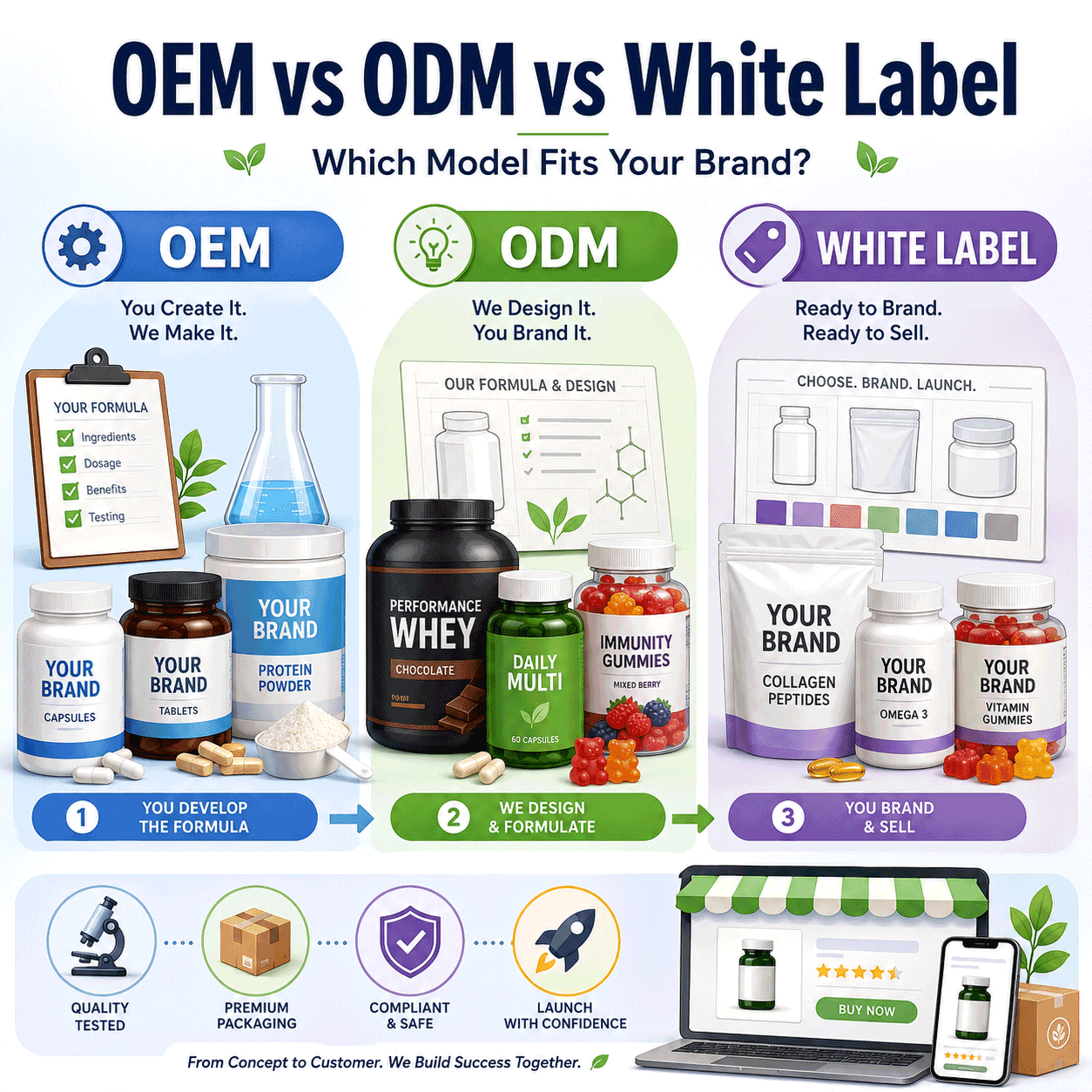
Supplement OEM means original equipment manufacturing in the supplement industry. In this model, the brand usually provides the product idea, formula direction, ingredient list, dosage requirements, quality requirements, packaging expectations, and sometimes even detailed manufacturing instructions. The manufacturer then focuses on manufacturing supplements according to the brand’s requirements.
This model is usually suitable for supplement brands that already know what they want to create. They may have a unique formula, an internal research team, a clear product line strategy, or a strong brand vision. They may also have specific supplement manufacturing needs, such as a high-protein powder, a clean-label capsule formula, a probiotic tablet, a sports nutrition blend, or gummy vitamins with special flavor and texture requirements.
The biggest benefit of supplement OEM is complete control. The brand can control the formula, ingredient positioning, dosage form, label direction, packaging style, target price, and customer experience. This is important for brands that want to build long-term value instead of selling generic products. A unique formula can support product differentiation and help the brand stand out in online marketplaces, retail channels, distributor networks, and professional health channels.
However, supplement OEM also requires more resources. Custom formulation takes time. Raw material sourcing must meet safety and quality standards. Stability testing may be required, especially for gummy vitamins, probiotics, liquids, powders with sensitive actives, or formulas with complex ingredients. Production costs may be higher because custom formulas often require more research, more sampling, and more manufacturing preparation. Minimum order quantities may also be higher because the manufacturer needs to purchase specific ingredients, packaging materials, and production resources for that brand.
For companies that want to build high quality products with a clear market advantage, supplement OEM can be a strong choice. But it is usually not the easiest path for beginners with limited budgets, unclear supplement ideas, or no experience with supplement regulations.
White Label Supplements for Faster Market Entry
White label supplements are usually pre-developed products that are ready for branding. The manufacturer already has existing formulas, dosage forms, production processes, testing records, and sometimes packaging options. The brand chooses from an available range of products, applies its own label and graphic design, and prepares the product for sale.
This model is attractive because it can reduce development time, production costs, and risk. A new company can enter the market faster without building a custom formulation from zero. A distributor can test demand in a new category. A wellness business can create a small supplement product line without hiring a full research and development team. An online seller can launch products more quickly on online marketplaces and use real customer feedback to decide whether to expand.
White label supplements are especially useful when the brand’s priority is speed. If a company wants to test vitamins, minerals, protein powders, capsules, tablets, gummy vitamins, or functional foods with a limited budget, white label may be the most practical starting point. The minimum order may be lower than full OEM, and the entire process is usually easier to manage.
The limitation is product differentiation. Because the formula may be available to multiple clients, the brand has less control over uniqueness. The product may still be high quality, but it may not be exclusive. This can affect conversion rates in crowded online marketplaces where many sellers use similar labels, similar claims, and similar product benefits. A brand that depends only on white label supplements may need stronger graphic design, packaging, customer service, pricing strategy, and advertising to stand out.
White label is not a poor business model. It is simply a different model. It can be smart for market testing, fast launches, and low-risk entry. But for brands that want a unique formula, premium positioning, or long-term product differentiation, white label may become limiting over time.
How to Choose the Right Dietary Supplement Business Model
Match the Model With Your Brand Stage and Supplement Manufacturing Needs
The best business model depends on the brand’s stage. A startup brand usually has different needs from an established brand. A distributor has different needs from a company building its own consumer brand. A business selling through online marketplaces has different needs from a company selling through clinics, pharmacies, gyms, or international distributors.
For a startup brand, white label supplements or ODM-style development may be a good starting point. The company may not yet know which products customers want to buy, which price point works, or which label design produces better conversion rates. In this situation, spending too much money on full supplement OEM can be risky. A faster launch model can help the brand test market trends, learn from customers, and improve future decisions.
For a distributor, private label supplements or ODM may be more suitable. Distributors often understand customer demand and sales channels, but they may not have an internal formulation team. They may know they want to sell nutritional supplements, functional foods, capsules, tablets, or gummy vitamins in a specific market, but they need an experienced team to help create a practical formula, choose a dosage form, review supplement regulations, and manage packaging.
For established brands, supplement OEM and custom formulation often create greater long-term value. Established brands usually have clearer customer data, stronger market knowledge, and more resources. They may want to develop custom formulas that match their brand vision, expand their product line, or create products that competitors cannot easily copy. For these brands, complete control over formula, label, packaging, stability testing, and quality can become a strategic advantage.
The more a brand needs speed, lower costs, and quick validation, the more white label or ODM may fit. The more a brand needs uniqueness, complete control, and long-term differentiation, the more supplement OEM and custom formulation may fit.
Compare Minimum Order, Production Costs, Speed, and Product Differentiation
Minimum order is one of the first questions clients ask dietary supplement manufacturers. This is understandable because minimum order affects cash flow, inventory risk, shipping costs, warehousing, and total launch budget. However, minimum order should not be viewed separately from the business model.
White label supplements often have lower minimum order requirements because the manufacturer already has a formula and may have an established production process. This can help brands save money during the first launch. It also reduces the risk of holding too much inventory before understanding demand.
Supplement OEM may require a higher minimum order because the formula, raw materials, packaging, and production process are more specific. If a product uses special active ingredients, custom flavors, unique packaging, or a difficult dosage form, the manufacturer may need a larger production run to make the project efficient. The brand may also need to invest more in sampling, testing, label review, graphic design, and stability testing.
Production costs also vary by product type. Tablets, capsules, powders, liquids, and gummy vitamins all have different manufacturing requirements. A simple capsule formula may have a lower production cost than a complex gummy vitamin with multiple active ingredients. A powder product may appear simple but can become more expensive if the formula requires flavor masking, anti-caking control, solubility improvement, or special packaging. Functional foods may require even more careful process control because taste, texture, shelf life, and consumer experience are critical.
Speed is another key factor. White label supplements can usually enter the market faster. ODM is slower than white label but faster than full OEM because the manufacturer contributes more development resources. Supplement OEM is usually the longest path because the brand wants more control and often needs more testing, sampling, and validation.
Product differentiation is the trade-off. A fast product is not always a differentiated product. A custom formula may take more time and cost more money, but it can support a stronger brand story. A white label product may launch quickly, but the brand must work harder through label design, packaging, customer education, price strategy, and online marketing to create a clear reason for customers to choose it.
What a One Stop Shop Supplement Manufacturer Should Provide
From Custom Formulation to Stability Testing and Quality Requirements
A strong one stop shop supplement manufacturer should support more than production. Many brands need help with the entire process, from supplement ideas to finished goods. This includes market research, custom formulation, raw material sourcing, sampling, flavor adjustment, dosage form selection, supplement regulations, quality testing, packaging, graphic design, manufacturing, labeling, documentation, and shipping.
Custom formulation is especially important for private label supplements and supplement OEM projects. A formula should not only look impressive on paper. It must be manufacturable, stable, safe, compliant, and suitable for the target consumer. An experienced team should understand how ingredients interact, how dosage affects taste and texture, and how manufacturing conditions affect the finished product.
Stability testing is a major part of quality. It is especially important for gummy vitamins, probiotics, liquids, powders, softgels, and formulas with sensitive vitamins or botanical ingredients. Stability testing helps confirm whether the product can maintain its appearance, taste, texture, active content, safety, and label claim during shelf life. A product that tastes good during sampling may still fail if it changes color, loses potency, becomes sticky, absorbs moisture, or develops microbiological issues later.
Quality requirements should be discussed before production begins. Brands should ask about raw material testing, finished product testing, microbiological testing, heavy metals testing, allergen controls, batch records, certificates of analysis, and storage conditions. If the product is intended for the USA market, brands may also ask about FDA registered facilities. However, brands should understand that facility registration does not mean the FDA has approved the dietary supplement. It is only one part of a broader quality and compliance picture.
Certifications can also matter. Some brands may require NSF GMP, GMP, ISO, organic, halal, kosher, vegan, gluten free, or other certifications depending on the market and product type. Certification is not only a marketing symbol. It can also support retailer confidence, distributor confidence, and customer trust when properly used and verified.
In the supplement industry, quality is the gold standard. Low production costs may help in the short term, but poor quality can damage reviews, repeat purchases, online marketplace performance, and brand credibility. High quality products depend on both good formulation and disciplined manufacturing.
Graphic Design, Packaging, and Online Marketplaces Support
For many supplement brands, packaging is not only a container. It is part of the customer experience and part of the sales process. This is especially true on online marketplaces, where customers make quick decisions based on product images, label clarity, benefits, ingredient presentation, reviews, and trust signals.
Graphic design should support both conversion rates and compliance. A beautiful label can attract attention, but it also needs to present information clearly and responsibly. The label should support the brand vision while also communicating product type, serving size, ingredients, directions, warnings, certification icons, and benefits in a compliant way. A label that is visually attractive but confusing or risky can create problems later.
Packaging decisions also affect costs and quality. Bottles, jars, pouches, sachets, stick packs, cartons, blister packs, and bulk containers all have different cost structures, minimum order requirements, shipping costs, and storage conditions. A premium glass bottle may look beautiful but increase shipping costs and breakage risk. A pouch may reduce weight but require strong sealing and moisture control. Gummy vitamins may need packaging that protects texture and reduces moisture exposure. Capsules and tablets may need desiccants, proper bottle size, and suitable closure systems.
A one stop shop manufacturer can help brands connect formula, packaging, graphic design, production, and market needs. This matters because product development often fails when these parts are handled separately. A designer may create a label that does not fit the bottle. A brand may choose packaging that increases shipping costs too much. A formula may require stronger moisture protection than the selected pouch provides. A product may look premium but fail to meet the price expectations of the target market.
Online marketplaces also create specific challenges. The product image must be clear. The label must be readable. The front panel must explain the product quickly. The formula must match customer demand. The benefits must be communicated without making illegal or exaggerated claims. The price must support advertising costs and conversion rates. For brands selling online, supplement manufacturing is not separate from marketing. The product itself must be designed for the sales channel.
Building a Product Line That Can Grow With the Market
Use Market Trends Without Losing Brand Vision
Market trends are useful, but they should not control every product decision. Increasing demand for certain ingredients, dosage forms, or health categories can help brands identify opportunities. For example, gummy vitamins may be popular because consumers enjoy convenient and pleasant formats. Capsules remain familiar and practical for many dietary supplement products. Tablets can be efficient for vitamins and minerals. Powders are strong for protein, sports nutrition, hydration, and functional blends. Functional foods can create new usage occasions and customer experience.
However, a brand should not create a product only because the trend is hot. The product must still fit the brand vision, target consumer, price range, manufacturing capability, and quality requirements. A brand known for professional sports nutrition may not need to chase every beauty gummy trend. A wellness brand focused on clean daily nutrition may not need an aggressive bodybuilding formula. A distributor serving pharmacies may need a different product line from an online seller targeting social media customers.
A strong product line is built with logic. Each supplement should have a reason to exist. The formula should match the customer need. The dosage form should match the ingredient. The label should match the market. The price should match the channel. The packaging should match the customer experience. The manufacturer should help the brand think through these decisions instead of simply producing whatever the brand requests.
Product differentiation becomes more important as the market becomes more crowded. If many supplement brands sell similar products, customers compare price, reviews, packaging, claims, and trust. A unique formula, better flavor, stronger testing, cleaner label, more suitable packaging, or better educational content can help the brand stand out. This is why custom formulation and supplement OEM are often valuable for brands with long-term goals.
Choose Manufacturers That Can Support Expansion
A brand may start with one product, but success often requires expansion. A company may begin with one private label supplement and later develop a full product line of vitamins, minerals, powders, capsules, tablets, gummy vitamins, functional foods, or sports nutrition products. The manufacturer should be able to support this growth.
Expansion requires more than production capacity. It requires stable quality, consistent communication, documentation, regulatory support, flexible packaging options, cost control, and experienced project management. If a manufacturer can only make one product type, the brand may need multiple suppliers as it grows. This can increase complexity, shipping costs, quality risk, and communication problems.
A one stop shop partner can reduce this pressure by supporting a broader range of services. The same team can help develop the formula, adjust the dosage form, manage graphic design, review label requirements, coordinate packaging, produce samples, run stability testing, manufacture the final product, and support after-sales questions. This can make the entire process more efficient for both startups and established brands.
Brands should also evaluate whether manufacturers can support different markets. Supplement regulations vary by region, and a product that works in one country may need changes before being sold elsewhere. Ingredient limits, label wording, certification needs, health claims, warning statements, and packaging requirements can all differ. A brand planning to expand should choose a manufacturer that understands international supplement regulations and can provide resources for market entry.
A manufacturer’s team matters as much as its machines. An experienced team can identify risks before they become expensive problems. They can explain why a gummy formula may need stability testing, why a capsule serving size may be too large, why a powder may cake during storage, why a label claim may be risky, or why a packaging choice may increase costs. This type of guidance can save the brand time, money, and stress.
Conclusion: Choose the Model That Matches Your Brand’s Stage, Budget, and Long-Term Strategy
Supplement OEM, private label supplements, ODM, and white label supplements all have value. The right choice depends on the brand’s stage, supplement manufacturing needs, budget, minimum order expectations, product line goals, and long-term business model.
White label supplements are often suitable for fast market entry, lower production costs, and early product testing. They can help startups and distributors enter the market quickly and learn from customers. However, they may offer limited product differentiation.
ODM and private label models can give brands more flexibility. They are useful when a brand has a clear direction but needs an experienced team to help with custom formulation, packaging, supplement regulations, and production. This model can balance speed, cost, and differentiation.
Supplement OEM is often the best fit for brands that want complete control, custom formulas, high quality products, and long-term competitive advantage. It usually requires more resources, longer development time, higher minimum order, and stronger quality planning, but it can help create a unique formula and stronger brand value.
No matter which model a company chooses, quality should remain the gold standard. A strong manufacturing partner should support safety, stability testing, label accuracy, packaging, graphic design, regulatory awareness, and customer experience. FDA registered facilities, NSF GMP, testing documents, and clear production records can all support trust, but brands should still evaluate the entire process carefully.
The supplement industry will continue to grow, and increasing demand will continue to attract new brands, new manufacturers, and new product ideas. In this competitive landscape, success will not come from choosing the fastest or cheapest option alone. It will come from choosing the right business model, the right manufacturer, and the right product strategy.
For a supplement brand, the best partner is not just a company that can produce supplements. The best partner is a one stop shop team that understands the formula, the market, the customer, the regulations, the packaging, and the brand vision. When all of these elements work together, brands can create products that are easier to sell, easier to trust, and easier to expand into a stronger long-term business.